OSWIECIM: Angela Merkel visited the former Auschwitz Nazi death camp on Friday for the first time as chancellor and said admitting Nazi crimes was a key part of Germany’s identity that could combat growing anti-Semitism.
“Remembering the crimes... is a responsibility which never ends,” Merkel said during the visit in a message aimed at calls from the German far right for a shift away from a culture of remembrance and atonement.
“To be aware of this responsibility is part of our national identity, our self-understanding as an enlightened and free society,” she added.
Merkel is only the third chancellor ever to visit a place that has come to symbolise the Holocaust.
She expressed Germany’s “deep shame” at what happened in Auschwitz and neighbouring Birkenau, where a million Jews lost their lives between 1940 and 1945.
“I bow my head before the victims of the Shoah,” she said, speaking in front of Polish Prime Minister Mateusz Morawiecki and a survivor of the camp, 87-year-old Bogdan Stanislaw Bartnikowski.
The 65-year-old chancellor, who was born nine years after the end of World War II, also addressed a rise of anti-Semitic and other hate crimes in Germany in recent years, saying they had reached an “alarming level”.
“To combat anti-Semitism, the history of extermination camps has to be shared, it has to be told,” she said. Auschwitz “demands that we keep the memory alive”.
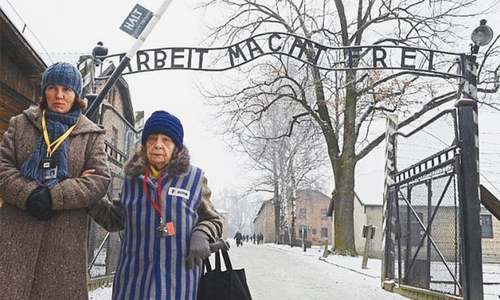
Merkel began her visit by walking under the Nazi slogan “Arbeit macht frei” (Work will set you free) that still hangs over the gates of the camp.
She marked a minute’s silence by the Death Wall where thousands of prisoners were shot dead and visited the site of a gas chamber and a crematorium.
In total, 1.1 million people were killed at Auschwitz-Birkenau, including non-Jewish Poles, Soviet prisoners of war, Roma and anti-Nazi fighters. Many were killed the same day they arrived at the camp.
“There is no other place of memory that demonstrates with such precision what happened during the Shoah,” Josef Schuster, head of the Central Council of Jews in Germany, who accompanied Merkel, said.
On the eve of her trip, Germany’s federal state approved a new 60-million-euro ($66-million) donation for the Auschwitz-Birkenau Foundation, which is marking 10 years since it was set up.
“This is an important and significant step towards keeping the memory of the Shoah,” Israel’s embassy to Germany said on Twitter.
Merkel follows in the footsteps of previous German chancellors Helmut Schmidt, who came in 1977, and Helmut Kohl, who visited in 1989 and 1995.
She has already visited several former concentration and extermination camps in Germany over many years and has been to Jerusalem’s Yad Vashem Holocaust memorial centre five times.
In 2008, she became the first German leader to address the Israeli parliament.
Merkel has called the Holocaust a “break with civilisation” and has voiced concern about the rise of anti-Semitism in Germany.
Her visit comes two months after an attack aimed at a synagogue in the eastern city of Halle in which two people were killed — part of a growing trend.
Published in Dawn, December 7th, 2019