Iraqi PM agrees to resign after Sistani’s call

BAGHDAD: Iraqi Prime Minister Adel Abdul Mahdi announced his resignation on Friday after the country’s top cleric urged lawmakers to reconsider their support for a government rocked by weeks of deadly anti-establishment unrest.
The move was the latest twist in an unprecedented crisis for war-weary Iraq, which has struggled to recover from decades of conflict, civil unrest and sanctions.
The departure of Abdul Mahdi could be a blow for Iranian influence after Iran’s militia allies and its own commanders intervened last month to keep the premier in place despite mass anti-government unrest.
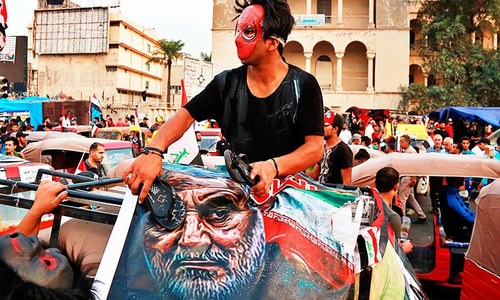
Iraq’s biggest unrest for years pits protesters from Shia heartlands in Baghdad and the south against the ruling elite seen as a pawn of Iran.
Three more killed as violence rages on
Iraq’s current political class is drawn mainly from powerful Shia politicians, clerics and paramilitary leaders including many who lived in exile before a US-led invasion overthrew dictator Saddam Hussein in 2003, including Abdul Mahdi.
“In response to this (the cleric’s) call, and in order to facilitate it as quickly as possible, I will present to parliament a demand (to accept) my resignation from the leadership of the current government,” a statement signed by Abdul Mahdi said.
The statement did not say when he would resign. Parliament is to convene an emergency session on Sunday to discuss the crisis.
Grand Ayatullah Ali al-Sistani earlier urged parliament to considering withdrawing its support for Abdul Mahdi’s government to stem spiralling violence.
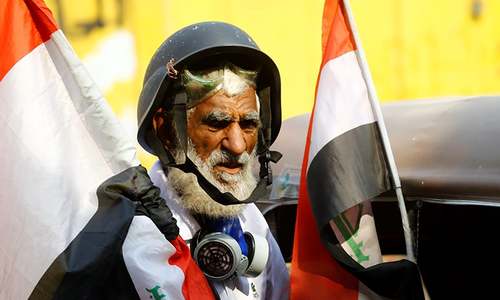
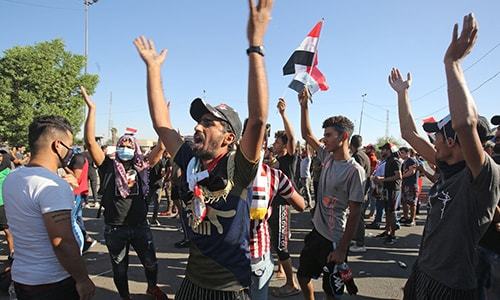
Iraqi protesters celebrated the imminent departure of Abdul Mahdi, but said they would not stop their demonstrations until the whole of the political class was removed. Violence continued in southern Iraq.
“Abdul Mahdi’s resignation is just the beginning. We’ll stay in the streets until the entire government has gone, and all the rest of the corrupt politicians,” said Mustafa Hafidh, a protester at Baghdad’s Tahrir Square.
“It’s not enough,” said Ali al-Sayeda, another demonstrator. “We need them all out, root and branch. We can’t let up the pressure.”
Violence unabated
Security forces, meanwhile, shot dead at least three people in the southern city of Nassiriya as clashes continued.
Unidentified armed men shot live rounds at demonstrators in Najaf, sending dozens scattering.
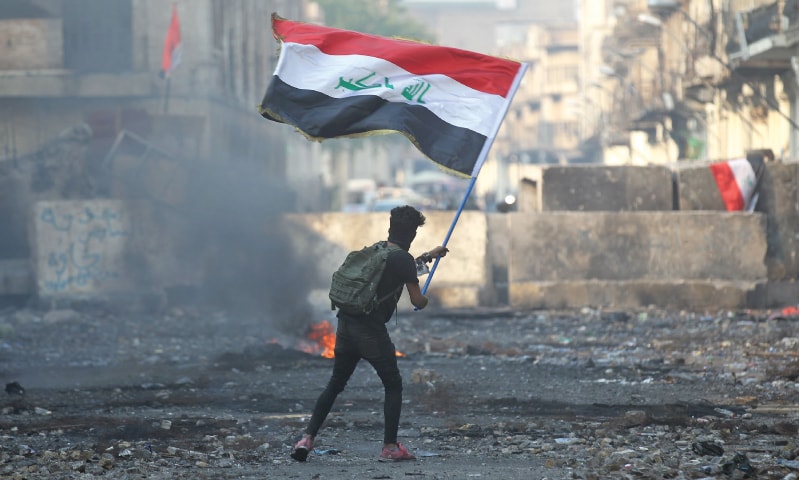
Iraqi forces have killed nearly 400 mostly young, unarmed demonstrators since mass anti-government protests broke out on Oct 1. More than a dozen members of the security forces have also died in clashes.
The burning of Iran’s consulate in the holy city of Najaf on Wednesday escalated violence and drew a brutal response from security forces who shot dead more than 60 people nationwide on Thursday.
Published in Dawn, November 30th, 2019