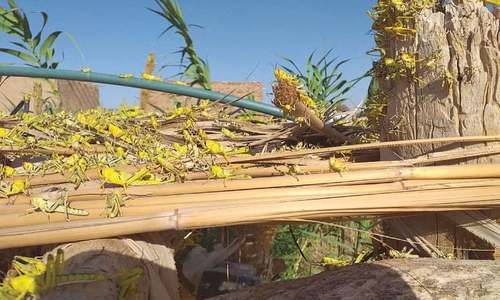
KARACHI: As swarms of locusts descended upon Karachi and spread from Malir and Korangi areas to other parts of the city on Monday, the federal and provincial authorities, while ruling out any damage, termed the recent activity as part of the creature’s migration process.
It all began on Sunday afternoon when photos and videos of locusts were shared over social media by different individuals, who claimed that the Malir and Korangi areas had come under a locust attack.
The authorities confirmed the movement of swarms of locusts but denied that any attack on the crops in the city’s rural parts took place.
Sindh Agriculture Minister Ismail Rahu held a meeting and decided to send experts with a fumigation team to the affected areas.
“The sudden emergence of locust is in fact their migratory process,” the minister said in a statement. “The people of Karachi should not worry as it is a harmless activity and has almost come to an end. A team of the Sindh agriculture department with experts is monitoring the situation and so far nothing damaging has been reported in any part of the city.”
Sindh agriculture minister tells public not to fear, but enjoy locust biryani & karahi
In a bid to allay fears and concerns of Karachiites, the minister also came up with a suggestion when he asked the people not to be scared of locusts as “one can cook biryani and karahi of it. Enjoy grasshoppers’ dishes and benefit oneself”.
After scaring the people in Korangi and Malir on Sunday, the swarm of locusts emerged in Gulshan-i-Iqbal, Bahadurabad and New Town on Monday, where a playground of a known private school and the lawn of one of the city’s major health facilities were filled with locusts within a few minutes.
The situation forced the school management to suspend classes for a brief time while a cricket match at the National Stadium met the same fate.

The situation normalised in less than an hour and then came an advisory from the federal government that further eased the situation.
The plant protection department of the national food security ministry termed it a migration of locusts, saying it would not cause any damage as this movement was not in search of food.
The technical director of the plant protection department, Mohammad Tariq Khan, while responding to the locust situation said that the instant desert locust activity observed in Malir and adjoining areas in Karachi is in fact a migration from summer-monsoon breeding zone towards coastal areas of Balochistan.
He explained that desert locusts fly during daytime and settle during night, and such migrations do not usually cause damages as this movement is not in search of food.
However, the department was closely monitoring the situation and the desert locust control teams were ready for its control if required as per the technical guidelines, he said.
Mr Khan explained that the desert locusts’ preferred habitat was desert areas, as sandy soil with moisture and vegetation was required for their oviposition, breeding and multiplication.
In Pakistan, the desert locust has two breeding seasons and regions: winter-spring breeding zone located in desert areas of Balochistan, which prevails during February to June; and summer-monsoon breeding zone located in Tharparkar, Nara and Cholistan deserts, which occurs during June-November.
Published in Dawn, November 12th, 2019