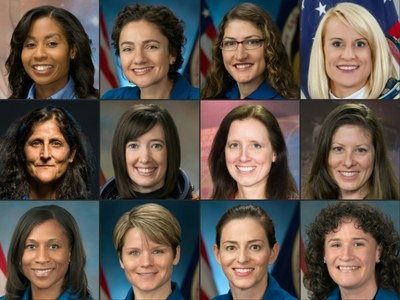
WASHINGTON: US astronauts Christina Koch and Jessica Meir became the first all-female pairing to carry out a spacewalk on Friday, a historic milestone as NASA prepares to send the first woman to the Moon.
The mission was originally planned for earlier this year but had to be aborted due to a lack of properly fitting spacesuits, leading to allegations of sexism.
“Christina, you may egress the airlock,” spacecraft communicator Stephanie Wilson told the pair as they set out to replace a power controller on the International Space Station at 1138 GMT.
NASA plans to send woman to the Moon
They began their mission with standard safety checks on their suits and tethers, before making their way to the repair site on the station’s port side, as the sunlit Earth came into view.
In a call to reporters a few minutes earlier, NASA administrator Jim Bridenstine emphasised the symbolic significance of the day.
“We want to make sure that space is available to all people, and this is another milestone in that evolution,” he said.
“I have an 11-year-old daughter; I want her to see herself as having all the same opportunities that I found myself as having when I was growing up.”
The first all-female spacewalk was supposed to take place in March but was cancelled because the space agency had only one medium-sized suit, with a male-female combination performing the required task at a later date.
Traditionally male-dominated NASA’s failure to be adequately prepared was denounced in some quarters as evidence of implicit sexism.
Koch, an electrical engineer who is leading the mission, was carrying out her fourth spacewalk and was hooked up to the station’s robot arm.
Meir, who holds a doctorate in marine biology and was making her first spacewalk, made her way carefully across using handles. The two were working to replace a faulty battery charge/discharge unit, known as a BCDU.
The station relies on solar power but is out of direct sunlight for much of its orbit and therefore needs batteries, and the BCDUs regulate the amount of charge that goes into them.
The current task was announced on Monday and is part of a wider mission of replacing ageing nickel-hydrogen batteries with higher capacity lithium-ion units.
The US sent its first female astronaut into space in 1983, when Sally Ride took part in the seventh Space Shuttle mission, and has now had more women astronauts than any other country.
But the first woman in space was Soviet cosmonaut Valentina Tereshkova in 1963, followed by compatriot Svetlana Savitskaya in 1982, who was also the first woman spacewalker two years later.
Ken Bowersox, NASA’s acting associate administrator, said he hoped that an all-female spacewalk would soon be a “routine” matter that would not require celebration.
Asked why it had taken so long — Meir is the 14th US woman spacewalker — he said men’s added height provided an advantage. “There have been a lot of spacewalks where very tall men who are the ones that were able to do the jobs because they were able to reach and do things a little bit more easily,” he said.
“But we’ve also brought women into the crews, because of their brains, right; they come in and they bring different skills, they think of things different ways. And by using their brains, they can overcome a lot of those physical challenges.”
NASA plans to return to the Moon by 2024 for the first time since the Apollo landings of 1969 - 1972. The new mission is named Artemis, after the twin sister of Apollo in Greek mythology.
The mission will see the first woman to set foot on the lunar surface, likely as part of a male-female combination, as the space agency looks ahead to a crewed Mars expedition in the 2030s.
Published in Dawn, October 19th, 2019