Oil, Iran top agenda as Russia's Putin visits Saudi Arabia


Russian President Vladimir Putin arrived in Saudi Arabia on Monday, where he was set to seal oil agreements and try to use his influence to defuse tensions boiling in the Gulf.
His meetings with King Salman and Crown Prince Mohammed bin Salman come following attacks on Saudi oil installations that Riyadh and Washington have blamed on Moscow ally Tehran.
Oil will be “the main topic of discussion” between the leaders, Russian political analyst Fydor Lukyanov said, as a deal between the Organisation of the Petroleum Exporting Countries (OPEC) and Moscow is due to expire next spring.
Moscow is not a member of OPEC, but it has worked closely with the group to limit supply and push up prices after a 2014 slump that wreaked havoc on the economies of Russia and cartel heavyweight Saudi Arabia.
Moscow and Riyadh — a traditional ally of Washington — have made a striking rapprochement in recent years, marked in particular by King Salman's first visit to Russia in October 2017.
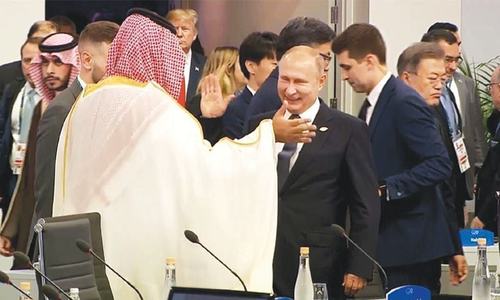
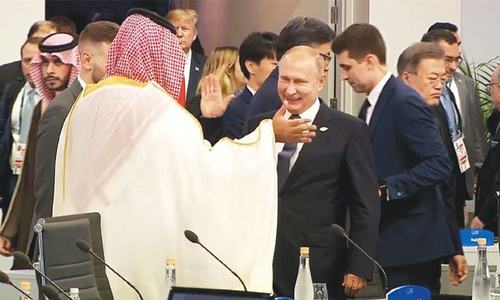
A year later, when the Saudi crown prince, known as MBS, was under fire over the assassination of the journalist Jamal Khashoggi in Istanbul, Putin went out of his way to shake his hand at a G20 summit, to much comment.
In an interview with Arabic-language television channels ahead of his visit, Putin praised his good relations with the Saudi royals.
“We will absolutely work with Saudi Arabia and our other partners and friends in the Arab world ... to reduce to zero any attempt to destabilise the oil market,” he said in the interview broadcast on Sunday.
'Role of peacemaker'
Analyst Lukyanov said that Moscow, with its older ties to Iran and new links with Saudi, could “play the role of peacemaker” as tensions soar between Tehran and Riyadh.
These tensions spiked last month after the attacks on Saudi oil facilities that halved the kingdom's crude output and set oil markets alight.
Yemen's Huthi rebels, who are allegedly backed by Tehran, claimed responsibility. But US officials blamed Iran and said the rebels did not have the range or sophistication to target the facilities.
Tehran has denied involvement and warned of “total war” in the event of any attack on its territory.
Russia has sought to keep a foot in both camps, proposing missiles to Riyadh to defend itself, while at the same time warning against “hasty conclusions” regarding Iran's alleged involvement.
Last week an Iranian tanker was hit by suspected missile strikes off the coast of Saudi Arabia, sparking fresh fears of war.
“As far as Russia is concerned, we will do everything possible to create the necessary conditions for a positive dynamic,” Putin said in the interview broadcast Sunday.
Syria war
Kremlin adviser Yuri Ushakov said Syria's eight-year-old war would also feature in the leaders' talks on Monday.
Russia and Iran back President Bashar al-Assad's regime, while the Saudis support the opposition. But “it is important for Russia that an Arab country participates in the political settlement in Syria,” said Lukyanov.
For now “only three non-Arab countries” — Turkey, Russia and Iran — are hosting talks, he said.
In terms of business, the visit is expected to result in around 30 agreements and contracts, according to Ushakov.
A dozen of these, in the advanced technology, energy and infrastructure sectors, will be signed by the Russian sovereign wealth fund and are worth around $2 billion.
In October 2017, Russia and Saudi Arabia also signed a memorandum of understanding paving the way for Riyadh's purchase of Moscow's powerful S-400 anti-aircraft missile systems.
The sale never materialised, however, as Saudi Arabia eventually opted to purchase a US system.
After Saudi Arabia, Putin will travel to the United Arab Emirates on Tuesday to meet the powerful crown prince of Abu Dhabi, Mohammed bin Zayed Al-Nahyan.