UK’s Mirpur community mourns quake victims


THOUSANDS of kilometres away from their loved ones in quake-hit Azad Jammu and Kashmir (AJK), British Pakistanis with roots in the region expressed their sadness and frustration after the disaster struck on Tuesday evening.
“There have been 10 deaths in my village,” said Sanawar Hussain, originally from Jatlan town. Although his father moved to London in the 1960s and him in 1990s, Hussain’s extended family still live there. “The level of sadness I feel is unimaginable.”
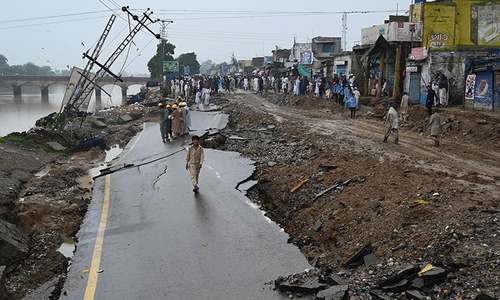
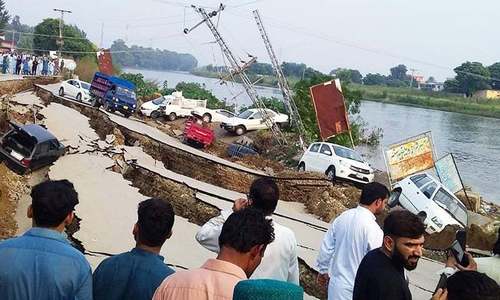
Hussain’s hometown is possibly one of the worst-hit in the powerful magnitude earthquake which ripped through northern Pakistan on Sept 24, killing 38 people and leaving scores injured. With its epicentre in New Mirpur City — the main city of the district — destruction in the area has been shocking. At least 200 of the 452 injured people are residents of Jatlan. Of the total injuries, 160 have been recorded as critical.
The Kashmiri diaspora was watching with dread as footage of shattered roads and gutted houses circulated in their WhatsApp groups.
“This afternoon was torture as I was not able to get through to friends. Mobile networks went down and the electricity was cut off,” said Hussain, adding that the main link roads were badly damaged. “My fear is they may not get the medicines they need. The night will be difficult for them.”
Questions raised about preparedness for natural disasters
Tasalat Hussain, the owner of an East London-based carpet business, said he was worried for his younger brother and uncle in Mirpur. “People are so terrified, my relatives tell me some have still not gone back into their houses for fear of another quake.” He added it was crucial for people to have shelter, as those whose homes had been destroyed didn’t have a roof over their heads.
The pain these men described was felt by thousands of Kashmiris living in cities across the UK. AJK, particularly Mirpur, has a deep affinity with the UK, where the majority of the over one-million strong Pakistani population has roots in Mirpur. The mass migration from Mirpur to Britain began in the 1960s when thousands of people had to leave their homes while the massive hydroelectric Mangla Dam was built. The British government welcomed them as they met the demand for factory workers, and facilitated their settlement in the Midlands and north of England.
Over the years, the Kashmiri diaspora maintained its ties to its hometown. Through remittances, British Pakistanis have invested in the uplift and development of their hometown, which some proudly call “little England”.
After the quake, MP Shabana Mahmood from Birmingham Ladywood tweeted her condolences. “My family originates from Mirpur, close to the quake’s epicentre. The UK must extend any support it can to help those affected by this tragedy.”
Preparedness
Pakistan High Commissioner to the UK Nafees Zakaria told Dawn: “I am establishing an emergency centre. There will be an exclusive desk with an official to receive calls from Kashmiris here who want to know about the wellbeing and whereabouts of their loved ones. My team is getting in touch with the AJK govt so that a focal person can be appointed to liaise with.”
It is largely because of this relationship and nostalgia that the British Pakistani community in the UK feels the loss of life and devastation in Mirpur so deeply. But as they pray for their families, some raise questions about preparedness for such natural disasters.
“After the 2005 earthquake in AJK, authorities knew that the area is on a fault line,” said Tahseen Gilani, originally from Kotli, and president of the JKLF UK. He added that the government should have invested in rescue services as well as technology which monitors seismic activity.
“Even the fire brigade doesn’t respond on time. Recently, I was told of an incident back home when a furniture shop caught fire. The fire truck arrived after 30 minutes. And when it did, the generator wouldn’t work. Community members had to arrange a private water tanker to douse the flames.”
Published in Dawn, September 26th, 2019