Punjab archives dept digitising ‘the biggest trove’ of history documents in subcontinent

LAHORE: Taking a major leap towards digitisation of its half-a-million documents carrying history right from the Mughal period, the Punjab archives department has sorted out 27,000 files and bought four specialised scanners to digitise these.
“The slow-paced digitisation, preservation and modernisation project of the Punjab archives department has been given a fresh boost, through major steps to protect the invaluable record and also make it available to people,” says Archives Director Abbas Chughtai.
According to him, a committee, on the request of the archives secretary, recently revised the cost of the project to Rs100 million, saving Rs57 million from the originally approved cost without reducing the scope of work. The project is being executed by the Punjab Information Technology Board (PITB) and funds have been placed at its disposal.
A number of tasks have been completed under the digitisation project, including the sorting of around 27, 000 files, more than 100 preliminary condition reports, preparation of digital coding rules and testing scan of almost 6,000 pages.
The research work is also being done on different topics, including fairs and communication networks in the British Punjab. The project website is completely functional with all the necessary information.
The sorted out 27,000 files contain the Colonial Period (1849-86) record of Lahore Residency, Sutlej Territories, Home General Department, Revenue Department, Judicial Department, Political Department, Mutiny Telegrams, Agencies Record. The process of sorting out is in progress.
The ‘Preliminary Condition Reports’ are the primary part of conservation and so far 103 such reports have been completed from the record of Mutiny Telegrams 1857 – 1858.
Similarly, cataloguing of 2,000 files have also been completed from the record of Mutiny Telegrams 1857 – 1858 and currently cataloguing of Agencies Record is in progress. The scanning of 5,721 pages from 112 files has been completed from the record of Mutiny Telegrams 1857–1858.
The director says that four book scanners (Comfort Basic Scanners) have been received from the PITB, but these will be installed in the Tomb of the Anarkali, Civil Secretariat, after reduction in temperatures. Once the scanners are installed and codal formalities are completed, the project will be inaugurated in near future.
Mr Chughtai says a state-of-the-art archives website that was launched in July this year is fully functional and is another step towards digitising the rare record.
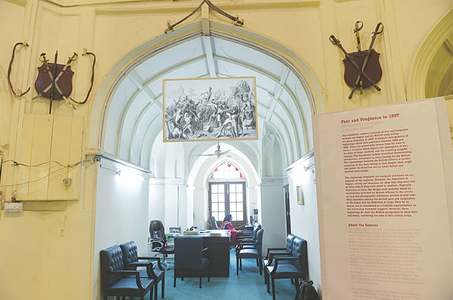
He claims the Punjab archives department maintains one of the biggest collections of historical documents in the subcontinent. This collection, housed partially in Anarkali’s Tomb in the Punjab Civil Secretariat, is estimated to contain 80,000 books and several million documents, besides a fine collection of lithographs, miniature paintings, seals and coins.
The documents, once kept in the rear portion of the chief secretary’s block, are stored in boxes in the upper portion of the Secretariat’s H Block ever since the colonial library was turned into chief secretary’s conference hall around a decade ago.
The archive was established in 1923 by Lt Col H L O Garret. The records storing in the archives began officially with the establishment of the Ludhiana and Ambala Agencies in the early 19th century. However a large number of documents which predate this are also available, the oldest of which dates back to the Mughal Emperor Shah Jahan’s rule in the 17th century. Extensive records from the Sikh and British rules in Punjab, as well as from other parts of the subcontinent, are found in the archives.
The English record includes a great bulk of documents from the government departments constituted under the Board of Administration which was established in Punjab after the province was annexed by the British in 1849. This collection also includes official documentation, gazetteers and correspondence not just from Punjab, but also from other areas of the subcontinent.
Records from the Delhi Residence and Agency were transferred to Punjab in 1857. Apart from this, records from Ludhiana, Ambala, Karnal and what was then the North-West Frontier as well as from the Peshawar and Dera Ismail Khan divisions and the Tribal Agencies, prior to the establishment of a separate administrative unit for that region, are also found in this collection. Also included are records from Sindh after it was annexed by Charles Napier up to the time the province became a part of the Bombay Presidency, as well as records from the occupation of the tribal areas of Balochistan.
The collection also includes reports on annual administration, budgets, typography, archaeology, medical and sanitary service, agriculture, forestry, census, revenue surveys, settlement industries and railways, submitted by various central and provincial commissions, committees and conferences.
The director says the digitisation under this project will be completed by June next year because of the personal interest shown by Archives Secretary Tahir Yousaf. The project will include selected documents from the Mughal and pre-colonial period. Bona fide scholars, researches and students would be able to get an online list of the archives. Copies would be provided on request and upon fulfilling a certain criterion, Mr Chughtai said.
Published in Dawn, September 23rd, 2019