South Africa acknowledges 'Afrophobia' partly to blame for violence against foreigners


 3
3


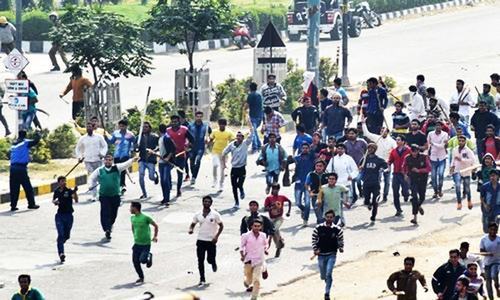
South Africa’s government acknowledged on Thursday that prejudice was partly to blame for deadly rioting that has targeted foreign businesses, as those attacks and reprisals overshadowed a continental economic conference for a second day.
President Cyril Ramaphosa had hoped the World Economic Forum (WEF) conference in Cape Town would serve as a shop window for his efforts to revive South Africa’s ailing economy and boost intra-African trade.
But the backdrop of violence has dominated proceedings, above all exposing dormant tensions between the host country and Nigeria, the continent’s two biggest economies.
At least five Africans have been killed this week in attacks on foreigners in South Africa. On Wednesday local companies MTN, and Shoprite closed stores in Nigeria after retaliatory attacks, and threats of reprisals forced Pretoria to shut its embassy in Abuja, its foreign minister said.
Nigeria’s vice president boycotted the meeting on Wednesday over the rioting.
On Thursday Jim Ovia, chairman of Nigeria’s Zenith Bank and a co-chair of the whole event, also withdrew, citing the “hypersensitivity of the issues surrounding the lives and well-being of Nigerian citizens living in South Africa.”
In Abuja, Nigeria’s Information Minister Lai Mohammed said it was recalling its High Commissioner to South Africa.
As his ministers sought to manage the fallout, Ramaphosa cancelled his appearance at the WEF plenary session to address a crowd of protesters demonstrating for a second day about violence against women.
Speaking in his place, Finance Minister Tito Mboweni said most South Africans disapproved of the attacks on foreigners and the principle of freedom of movement for citizens of the continent was key.
But animosities were generating violence, and politicians were partly responsible for resolving that. “We have to go to our people politically to discuss what some of them are doing is wrong.”
‘There is a targeting of Africans’
Foreign Minister Naledi Pandor said the government was aware of a resentment-driven “Afrophobia” and was working to restore calm. South Africa was also in constant contact with Nigerian authorities.
“There is a targeting of Africans from other parts of Africa, we can’t deny that,” she told Reuters on the sidelines of the conference.
“But, there is also criminality [...] because a lot of this is accompanied by theft,” she said, describing the attacks as a complex phenomenon whose root causes were not easy to define.
South African police, who have arrested hundreds in connection with the attacks, said they found two burnt bodies on Thursday in the Gauteng township of Katlehong, one of the areas that has seen rioting. The incident could not be immediately linked to anti-immigrant violence, they said.
Some trade traffic was also affected.
In neighbouring eSwatini, the National Agricultural Marketing Board said trucks that normally carry farm produce south across the border were being kept in their depot after advice from South African counterparts that it was not safe to travel.
“We have not been able to export since the week started [...] We are keeping our fingers crossed that things will normalise by next week,” said NAMBoard Agribusiness Manager Tammy Dlamini.