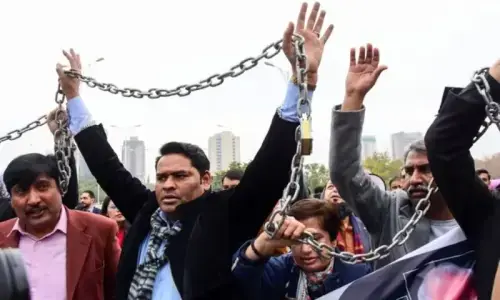
India-held Kashmir under lockdown

SRINAGAR: Authorities in India-occupied Kashmir imposed an indefinite security lockdown before Sunday midnight and ordered thousands of visitors out of the region.
Indian forces laid steel barricades and razor wire on roads and intersections to cut off neighbourhoods in Srinagar and other towns in the Kashmir valley.
“As per the order there shall be no movement of public and all educational institutions shall also remain closed,” a government statement said. It said public meetings and rallies were also being banned.
Authorities also suspended internet services and most mobile phone networks, a common tactic to prevent anti-India demonstrations from being organised and to stop dissemination of news.
Some pro-India Kashmiri leaders were also put under house arrest in Srinagar. Omar Abdullah and Mehbooba Mufti, former chief ministers, were among the ones put under house arrest. Abdullah said in a tweet: “This wasn’t the India” Kashmir “acceded to but I’m not quite ready to give up hope yet”.
In recent days, India has deployed at least 10,000 troops in Kashmir, with media reports of a further 25,000 ordered to one of the world’s most militarised regions. The measures have sparked fears that New Delhi is planning to scrap an Indian constitutional provision that forbids Indians from outside India-held Kashmir from buying land in the territory.
Thousands of additional Indian soldiers began camping in police stations and government buildings in several areas on Sunday.
Indian Prime Minister Narendra Modi is scheduled to chair a national security meeting on Monday.
Amid the government evacuation order, hundreds of Indian and foreign visitors, including some Hindu pilgrims, continued congregating outside the main terminal at the airport in Srinagar, seeking seats on flights out.
Tourists and pilgrims also took buses out of the region, with authorities busing out hundreds of Indian students from Srinagar colleges.
The order on Friday cited the “prevailing security situation” and the “latest intelligence inputs of terror threats with specific targeting” of the annual Hindu pilgrimage as reasons for the advisory. Several governments issued similar travel advisories.
Kashmiri politicians and ordinary residents fear the Indian government’s measures are a prelude to doing away with Kashmir’s special status and intensifying an ongoing crackdown against anti-India dissenters.
In its election manifesto earlier this year, Prime Minister Narendra Modi’s Bharatiya Janata Party promised to do away with special rights for Kashmiris under India’s constitution.
“India is getting cornered at the geostrategic level as America seeks Pakistani help for withdrawing from Afghanistan,” said Fayaz Ahmed, a political science teacher in Srinagar. “In turn, India is mounting pressure on Pakistan by building up tensions in Kashmir through militaristic approaches inside Kashmir as well as along the frontier.”
Syed Ali Geelani, a top Kashmiri leader who challenges India’s rule over the region, issued a statement late on Sunday calling on Kashmiris to use “unity and brotherhood” to fight “India’s aggression”.
Published in Dawn, August 5th, 2019