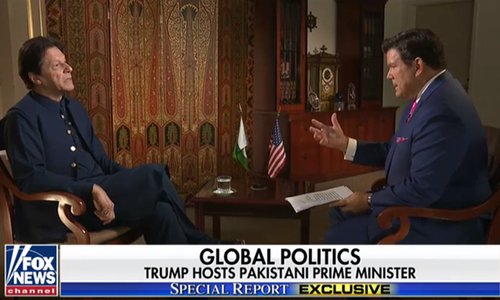
THERE are numerous takeaways from Prime Minister Imran Khan’s recent meeting with President Donald Trump in Washington. But perhaps the one that has grabbed the most attention is the US leader’s offer to mediate between Pakistan and India to resolve the Kashmir imbroglio.
“If I can help, I would love to be a mediator,” said Mr Trump while replying to a journalist’s question at a joint press conference with the prime minister. And perhaps the more explosive part of his offer was that the US president told the media that it was in fact Indian Prime Minister Narendra Modi who broached the subject while meeting Mr Trump two weeks ago.
“He actually said would you like to be mediator or arbitrator?” said Mr Trump quoting the Indian leader.
The Indian reaction was predictable; New Delhi’s external affairs ministry tweeted that “no such request has been made by PM”, while reiterating the standard Indian line that all outstanding issues with Pakistan be dealt with bilaterally. Imran Khan’s reaction was far more accepting, as the prime minister commented that the “prayers of over a billion people” of the subcontinent would be with the American leader should he help pave the way for peace in Kashmir.
Read: India denies Modi asked Trump to mediate Kashmir dispute
Donald Trump’s foreign policy style is unpredictable, to say the least. While he has been reckless on some fronts (Iran), on others (North Korea) he has gone the extra mile to try and resolve a decades-old dispute. Though he may throw caution and the principles of international relations to the wind, and deal with global issues in a highly personal manner, Mr Trump’s maverick tactics may just be what the Kashmir issue needs.
As for the veracity of his claims, only Mr Trump and Mr Modi can explain what the actual talking points of their conversation were. But from Pakistan’s point of view, Mr Trump’s idea of mediation is an excellent suggestion, because the bilateral approach till now has failed to bear fruit. While Islamabad and Delhi came tantalisingly close to a solution in 2001’s Agra summit, there has been little hope thereafter on this front where bilateral dialogue is concerned.
At the end, it is Pakistan, India and the Kashmiris who will have to take the final decision to resolve this over seven-decade-old imbroglio. But a little friendly ‘push’ from powerful global actors may help the stakeholders reach a mutually acceptable solution. Moreover, Indian rigidity has left little hope on the bilateral front, especially under Mr Modi’s watch, as Delhi keeps harping on about ‘terrorism’, without earnestly responding to Pakistan’s offers for dialogue.
Whether it is the US, the UN, or other global players, clearly a multilateral framework may be able to provide a conducive atmosphere for the resolution of the Kashmir issue. Delhi may be posturing to look ‘strong’ domestically, but it must realise that meaningful dialogue is the only solution for Kashmir.
Published in Dawn, July 24th, 2019