Court stops Musharraf’s lawyer from arguing in treason trial

ISLAMABAD: The special court seized with the high treason trial of former president retired Gen Pervez Musharraf barred his counsel from arguing on his behalf and directed the law ministry to appoint a defence lawyer.
The three-judge special court, headed by Chief Justice of the Balochistan High Court Tahira Safdar, decided to conclude the treason trial despite the absence of the accused person. The court has declared that Mr Musharraf has lost the right to engage a counsel, unless he surrenders.
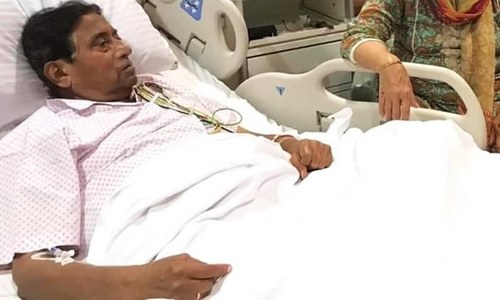
The former president has been declared an absconder by the special court as he has not been appearing before the court since March 2016, when he left the country. Currently, Mr Musharraf resides in Dubai and has been unable to attend hearings in Pakistan as he is reportedly receiving medical treatment for a rare disease.
The Supreme Court issued certain guidelines in April this year for the special court to conclude the trial.
Citing the apex court’s judgement, the special court in its Wednesday’s written order said: “In view of the established principle that a trial could not be held in abeyance or could be adjourned for an indefinite period couple with findings of the Supreme Court, whereby it was held that the accused being fugitive from law, thus loses his right to audience, also lost to have an advocate appointed to defend him unless he surrenders himself before the court.
“[…] As decided by the Supreme Court, the learned counsel presently representing the accused neither could represent him nor could defend him [the accused] with the exception [that] the accused appears and surrenders himself before the court.
“In the view of the described state of facts and in compliance [with] the decision given by the Supreme Court for further proceedings of the trial, a counsel is to be appointed to defend the accused as required by the Section 9 of the [Criminal Law Amendment (special courts)] Act 1976. The Ministry of Law and Justice, government of Pakistan, is directed to submit a panel of advocate for the purpose along with the package of fee to be paid to the advocate, so appointed to enable this court to further proceed with the case, as required.”
The decision to conduct trial in absentia came after Mr Musharraf’s counsel Barrister Salman Safdar informed the court that the former president was physically and mentally unfit to return to the country.
He argued that Mr Musharraf was suffering from a rare disease, fighting for his life and had lost weight, adding that he was on a wheelchair. He requested the court to grant the accused another exemption from appearance.
The court, however, observed that since Mr Musharraf had no right of audience till his surrender, Barrister Safdar could not argue on his behalf.
The hearing was adjourned till June 27.
Published in Dawn, June 13th, 2019