'Sophisticated' attacks on Saudi tankers likely work of a state actor, UNSC members told


The United Arab Emirates (UAE) told United Nations Security Council members on Thursday that attacks on four tankers off its coast on May 12 bore the hallmarks of a “sophisticated and coordinated operation,” most likely by a state actor.
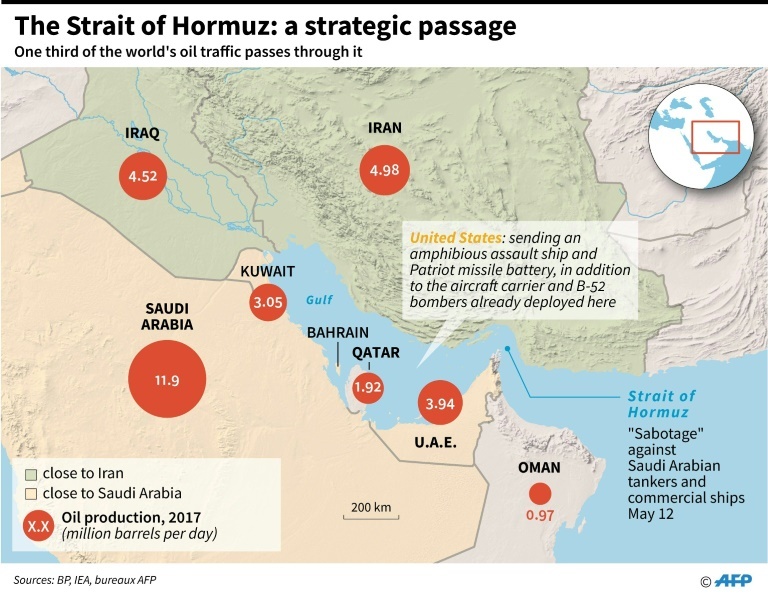
The May 12 attacks targeted two Saudi tankers, an Emirati vessel and a Norwegian tanker. A statement issued by the UAE's Foreign Ministry had placed the ships near the country's territorial waters in the Gulf of Oman, east of the port of Fujairah. The US Navy's 5th Fleet oversees the region.
The tanker attacks came after Washington deployed B-52 bombers and an assault ship to bolster an aircraft carrier in the region as it engaged in a war of words with Tehran, which had begun to roll back commitments set out in the 2015 nuclear deal that the US withdrew from last year.
Read more: Trump exit from Iran nuclear deal enters uncharted territory
In a document on the briefing to Security Council members, the UAE, joined by Norway and Saudi Arabia, did not say who it believed was behind the attacks and did not mention Iran.
The attacks required expert navigation of fast boats and trained divers who likely placed limpet mines with a high degree of precision on the vessels under the waterline to incapacitate but not sink them, according to the preliminary findings of the countries' joint investigation.
“While investigations are still ongoing, these facts are strong indications that the four attacks were part of a sophisticated and coordinated operation carried out by an actor with significant operational capacity, most likely a state actor,” the three countries said in the document.
They believe it was the work of several teams of operatives, which coordinated the timed detonation of all four explosive charges within less than an hour.
Explore: From 'threats' to military deployments: how US-Iran tensions escalated
The three countries said the attacks endangered commercial navigation and the security of global energy supplies. They plan to share the findings of their probe with the London-based International Maritime Organisation.
While the briefing document did not mention Iran, a Saudi diplomat in New York laid the blame squarely on the country.
“We believe that the responsibility for this action lies on the shoulders of Iran. We have no hesitation in making this statement,” said the Saudi ambassador to the UN, Abdallah Y. Al-Mouallimi.
In May, US President Donald Trump's administration deployed 1,500 more troops to the Middle East. In the weeks leading up to the attacks, the Trump administration hardened its policy against Iran by fully reimposing sanctions on Iranian oil exports and designating the IRGC as a foreign terrorist organisation.
Find out more: US alone in opposing Iran N-deal at UNSC
Trump reiterated this week that he wants to sit down with Iran's leaders to negotiate a new deal, a year after Washington pulled out of an accord between Iran and global powers to curb Tehran's nuclear programme in return for lifting international sanctions.
But Iran's Supreme Leader, Ayatollah Ali Khamenei, said on Tuesday that Tehran would not be “deceived” by Trump's offer.
'US showing force to establish deterrence without needless provocation'
A top commander of American forces in the Middle East on Thursday alleged that Iran has chosen to “step back and recalculate” after making preparations for an apparent attack against US forces in the Persian Gulf region, but it is too early to conclude that the threat is gone.
In an interview with three reporters who accompanied him to the Gulf, Gen Frank McKenzie said that he remains concerned by Iran's potential for aggression, and he would not rule out requesting additional US forces to bolster defences against Iranian missiles or other weapons.
“I don't actually believe the threat has diminished,” McKenzie said. “I believe the threat is very real.”
McKenzie, the head of US Central Command, and other military officials are trying to strike a balance between persuading Iran that the US is prepared to retaliate for an Iranian attack on Americans, thus deterring conflict, and pushing so much military muscle into the Gulf that Iran thinks the US is planning an attack, in which case it might feel compelled to strike preemptively and, thus, spark war.
In Baghdad, McKenzie told reporters from The Associated Press and two other media organisations that US redeployments to the Gulf have “caused the Iranians to back up a little bit, but I'm not sure they are strategically backing down.”
The general said the US is showing enough force to “establish deterrence” without “needlessly” provoking its longtime adversary.
“We're working very hard to walk that line.” He said he is confident in the moves he has made thus far.