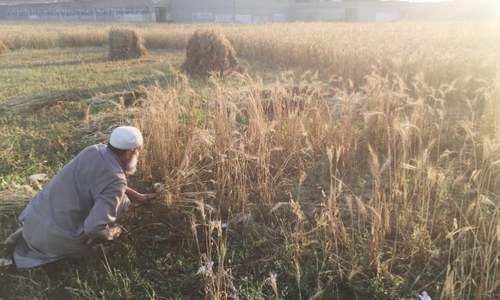
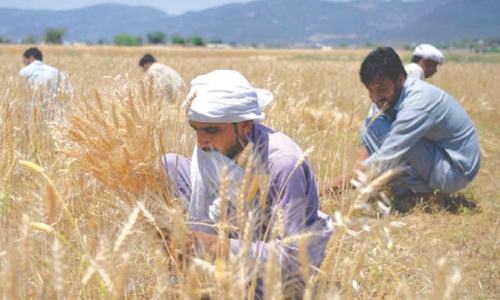
ISLAMABAD: Pakistan could not achieve the wheat production target this year largely due to unfavourable weather conditions that damaged the ready-to-harvest crop mainly in Punjab and Khyber Pakhtunkhwa, causing a loss of about 1.5 million tonnes of wheat.
Read: Govt likely to miss wheat crop target amid rains
Minister for National Food Security and Research Sahibzada Mahboob Sultan told a news conference here on Tuesday that wheat production this year had been estimated to be 24.12 million tonnes. The government already had 3.7 million tonnes in reserves, and all together the country had 27.19 million tonnes of wheat in stock, he said, adding that the country’s population had complete food security. Responding to a question about the compensation to farmers who lost the wheat crop due to natural calamity, the minister said that revenue board in Punjab was estimating the cost of loss. However, he was not clear as to when the government would announce a compensation package.
He said that the federal budget for agriculture prior to devolution was Rs38 billion. However, he added, after the devolution this was slashed to about Rs16 billion. How could the country progress when 70 per cent budget for agriculture was reduced, he regretted, blaming the previous governments for curtailing the budget for agriculture while commenting that “they could not find kickbacks in this sector and for that reason agriculture remained out of focus during their governments”.
Says country still enjoys complete food security
Mr Sultan said the PTI government led by Prime Minister Imran Khan had a vision and the maximum focus was on agriculture, and to revive agriculture being the backbone of the national economy, 13 projects costing Rs286 billion were being launched during the next fiscal year. These projects will be implemented in next five years. Out of this amount, the federal share was Rs86 billion, which shows the seriousness of the government towards agriculture, he said.
He told a questioner that the government had no plans to increase sales tax on fertiliser from 2pc to 17pc.
Mr Sultan explained to the journalists the two agreements which were signed with China during the current visit of Chinese Vice President Wang Qishan. The first memorandum of understanding relates to the ‘Framework Agreement on Agricultural Cooperation’ while the second memorandum relates to ‘Requirements of Food and Mouth Disease’ (FMD).
Under the memorandum on FMD, Chinese General Administration of Customs will provide technical assistance to the ministry of national food security and research for establishment of FMD Free Zones in the country where vaccination will be practised.
About agreement of FMD, Mr Sultan said that while world export of meat was increasing, the share of Pakistan in meat export was less than 200 million tonnes. The Chinese assistance would lead us to increase the export of meat, he said.
Under the ‘Framework Agreement on Agricultural Cooperation’ that covers all aspects of agriculture sector, China will share modern technology being applied in agriculture with Pakistan in addition to mechanisation skills that will benefit small farmers.
The China-Pakistan Economic Corridor has already developed a strong base for mutual cooperation between the two governments in a variety of fields which include agricultural development and poverty alleviation as one of the long-term key areas of cooperation.
The agreement identified areas of cooperation such as inputs and agricultural technology extension service; remote sensing and geographical information system; food processing and pre-and-post-harvest handling and storage of agricultural produce; genetic resources of crops, livestock and poultry; selection and breeding of new breeds of animals and new varieties of plants; feed; fisheries and aquaculture; research and development of new high-yield varieties; precision agriculture; and pest and disease control.
The agreement provides for jointly establishing agricultural technology demonstration parks to showcase technologies and agribusiness’s development models, and strengthen links and collaboration between businesses in the two countries.
Published in Dawn, May 29th, 2019