THERE is a long and ignominious history of the state, or powerful elements within it, declaring politically active citizens of Pakistan traitors, foreign agents or externally funded saboteurs of national peace and security.
As Pakistan matures as an independent country and nation, there should have been an expectation that the state would shed some of its worst proclivities, phobias and paranoias.
Instead, powerful elements within the state appear heedless of the past and seem determined to repeat historical mistakes that have driven a wedge between the people and the very state that exists to serve them.
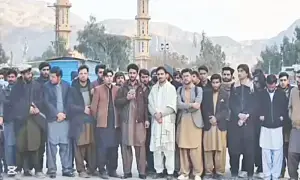
On Monday, an indigenous, organic ethnic rights movement was publicly and quite extraordinarily accused of being on the payroll of hostile foreign intelligence agencies.
In effectively declaring the Pashtun Tahaffuz Movement to be an enemy of the state, DG ISPR Maj Gen Asif Ghafoor has perhaps unwittingly cast the PTM in illustrious company.
Preposterous as it may appear today, the sister of this country’s founding father was once upon a time declared to be an agent of Kabul in a high-profile newspaper advertisement campaign sponsored by the state, the country’s first military dictator, Ayub Khan, fearing Fatima Jinnah’s challenge to his rule.
Before Fatima Jinnah, there was the case of Huseyn Suhrawardy, a Bengali politician and briefly prime minister of Pakistan. Suhrawardy, Pakistanis were told by the establishment of the 1950s, was a traitor to Pakistan.
G.M. Syed, a towering politician of Sindh, was imprisoned for decades on accusations of being anti-state and anti-Pakistan. The allegations ought to have been unthinkable — G.M. Syed moved the Pakistan Resolution in the Sindh Assembly, the first colonial legislature to do so — but they were cynically deployed to shut down a political opponent.
Wali Khan, Ataullah Mengal, Ghaus Bakhsh Bizenjo — each was at some point declared a traitor or foreign agent.
Perhaps most poignantly and tragically, Mujibur Rehman was vilified and declared to be a traitor to Pakistan.
Arguably, had an independent media existed at the time, the reality of events in East Pakistan could have been made known to the public and the catastrophe of secession avoided.
Instead, the military regime imposed a near total media censorship on actual events in East Pakistan.
Today, it is the turn of the PTM to suffer vilification and slander. More ominously, the DG ISPR’s press conference on Monday suggests that an attempt to dismantle and shut down the PTM is being contemplated in some quarters.
Some of the PTM’s rhetoric is ill advised and inflammatory. But the PTM as a whole is undeniably indigenous and organically founded. It is time for the prime minister to step up and embrace the disaffected and disillusioned youth of the PTM, whose demands are legitimate and constitutional.
Another generation of Pakistanis should not be lost to heedless state policies.
Published in Dawn, May 1st, 2019