SC to take up issues of security of judges’ tenure, independence later


 1
1


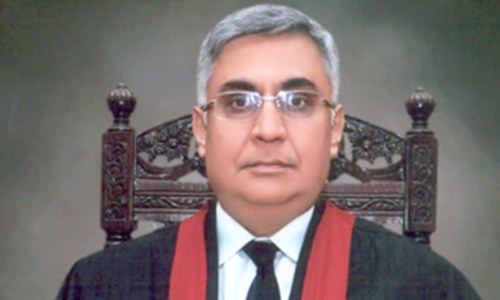
ISLAMABAD: The Supreme Court on Monday disposed of a petition filed by a former judge of the Lahore High Court, observing that the questions raised by the former judge relating to the security of the tenure of a judge and the independence of the judiciary would be taken up in some other cases later.
Mohammad Farrukh Irfan Khan, who tendered his resignation as LHC judge on April 9, is facing a reference before the Supreme Judicial Council (SJC) for possessing offshore properties.
The SJC initiated the reference when the name of Farrukh Irfan surfaced in a list of those Pakistanis who possess offshore properties.
A five-judge SC bench headed by Justice Mushir Alam disposed of the petition in view of the resignation of Mr Khan.
Apex court disposes of Justice Farrukh’s petition
The SC bench observed that since the former judge had not pressed for his petition in view of some subsequent events, the case was being disposed of, but the questions raised by him in the petition would be taken up later.
Advocate Hassan Irfan Khan, representing the former judge, contended that his client would not press for the petition after his resignation since the petition had become infructuous. But an authoritative judgement should come on the part of the apex court so that the issues relating to the security of judges’ tenure as well as the independence of judges be determined once for all, he said.
After serving for nine years as LHC judge, Farrukh Irfan resigned from the coveted office, saying he had no expectation to get justice or fair treatment from the SJC.
“It is thus with a very heavy heart that I am resigning from the post of the judge of the LHC,” Farrukh Irfan had stated in an eight-page resignation letter he furnished before the SJC.
While resigning the former judge had also accused the SJC of acting with a bias against him and with a previously made up mind, contrary to the merit and facts of the case. The letter accused the SJC of becoming a prosecutor rather than being adjudicators which should judge the matter in a fair and impartial manner to arrive at the truth.
“My one fault, it appears, is that during the initial hearing before SJC, ... reminded the members of the council that misconduct as a judge is to be looked into during his tenure on the bench and not the life of a judge prior to the elevation as an advocate of the courts of law,” the letter said, adding that the council during its hearing of April 8 had forfeited on its own his two prime witnesses and his daughter’s testimony, who had to come from abroad but could not manage due to some peculiar circumstances.
Absence of complainant
In his petition, the former judge questioned the SJC hearing against him by asking could the council proceed in the absence of the complainant, Nazar Mohammad Chohan, especially when the same was initiated on his complaint.
The petition wondered whether the complaint of a private person against a judge of the high court could be entertained, when the complainant had not offered himself for disposition orally or by way of affording opportunity of cross-examination.
The petition also asked should the proceedings against the high court not be liable to be discharged in the absence of examination in chief of the complainant, adding that the failure on the part of the prosecution to present any evidence in support of the allegation or statement of allegations through an examination in chief of the complainant had rendered it into a case of no evidence and thus the proceedings was liable to be discharged.
Whether the proceedings by the SJC in the absence of and without evidence from the complaint were repugnant to the requirement of fair trial and due process within the meaning of Article 10A of the Constitution, the petition asked. The petition said the Supreme Court had held repeatedly that for the removal of a judge of the superior court, evidence or standard of proof against the judge should be of highest quality.
The petition contended that the standard of proof being entertained against the high court judge would not stand to any reasonable degree or standard of proof.
The petition pleaded before the Supreme Court that the proceedings before the SJC be declared to be repugnant to the fundamental rights of the judge and should be declared illegal, unconstitutional and nullity in the eyes of the law.
Published in Dawn, April 30th, 2019