I’ll be the last person to make rules for writing: Arundhati Roy


 5
5


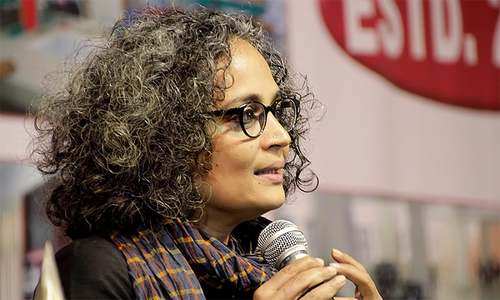
ISLAMABAD: Writing is the most appropriate way of expressing trauma and complications, and I will be the last one to make rules for writing in terms of impression and style, said acclaimed Indian Booker-winning author Arundhati Roy.
She was speaking on her novel The Ministry of Utmost Happiness while addressing a conference at International Islamic University Islamabad (IIUI) through Skype.
The conference, ‘Getting our bearings right: literature, society and prosperity’ was organised by the university’s English department in collaboration with its Iqbal Institute for Research and Dialogue.
“I have always quarreled with this word ‘activist’. I think it’s a very new word and I don’t know when it was born but it is recent. I don’t want to have a second profession added to writing,” she said.
To a question about the place and city in the novel, she said it’s a book that doesn’t pretend to universalise anything or conceptualise anything. It’s a book of great detail about a place.
When asked about her fiction and non-fiction works, she said: “I don’t actually see my fiction and nonfiction as extensions of each other. This novel has been 10 years in the writing but I think in the 20 years between The God of Small Things and now, I have travelled and been involved with so many things that are happening and written about them at length,” she said.
According to a press release issued by IIUI on Sunday, the conference was attended by 25 national and international speakers.
The speakers called for devising a comprehensive policy on adoption of national language and recommended establishing translation centres in universities.
Famous writer, critic and dean of arts and humanities at the University of Karachi, Dr Asif Farrukhi stressed the need to bring regional and Urdu language literature into English.
Sharing his views on Asad Mohammad Khan’s work, A New Harvest of Anger, he said historic themes, social and class conflicts as well as contradictions emerged from contemporary Urdu poetry and fiction, often not available in the current syllabi, and led to a limited understanding of Pakistani society.
Dr Shahid Siddiqui, educationist and dean of social sciences at the National University of Modern Languages, spoke on language, life chances and the Matthew effect.
Dr Tahir Khailiy, vice president academics at IIUI, said conferences of such importance would be a part of the activity calendar to determine role of literature in the prosperity and reconstruction of society.
Dr Ayaz Afsar, dean of faculty of social sciences, said one of the purposes of the conference was to encourage debate, interaction and networking among national and international experts and students.
Published in Dawn, April 29th, 2019