Antarctic penguins suffer ‘catastrophic’ breeding failure


 4
4


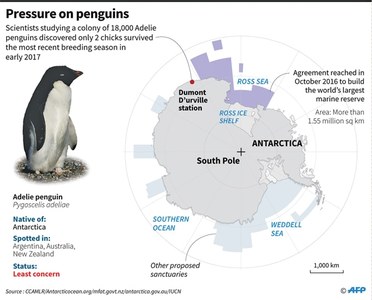
PARIS: The second largest emperor penguin colony on Earth has suffered a “catastrophic” breeding failure after nearly all chicks born over three years died as their icy Antarctic habitat shrinks, researchers said on Thursday.
The British Antarctic Survey (BAS) used satellite imagery to study the behaviour of the Halley Bay colony in the Weddell Sea due south of Cape Hope, which normally sees up to 25,000 penguin pairs mate each year.
They found that in 2016, when abnormally warm and stormy weather broke up the sea-ice on which the penguins normally raise their young, almost all the chicks died.
This pattern was repeated in 2017 and 2018.
The BAS said the colony at Halley Bay has “all but disappeared”.
“We have been tracking the population of this, and other colonies in the region, for the last decade using very high resolution satellite imagery,” said BAS remote sensing specialist Peter Fretwell.
“We can estimate the population based on the known density of the groups to give reliable estimate of colony size. These images have clearly shown the catastrophic breeding failure at this site over the last three years,” Fretwell added.
The team noted however that a nearby penguin colony at Dawson Lambton had “markedly increased in size”, indicating that many of the Halley Bay birds had migrated to safer breeding conditions.
BAS penguin expert Phil Trathan said it was impossible to know for sure if the break up of sea-ice at Halley Bay was caused by climate change.
“But such a complete failure to breed successfully is unprecedented at this site,” he said.
Emperors, the world’s largest penguin species, came to global fame with a 2005 documentary, March of the Penguins, portraying their annual trek across the icy wastes, and the 2006 cartoon movie Happy Feet.
But their population, centred around Earth’s extreme south, is set to decline up to 70 per cent by the end of the century as the planet continues to warm.
A study in 2015 recommended the birds be added to an international “Red List” of endangered species.
Published in Dawn, April 26th, 2019