0
0

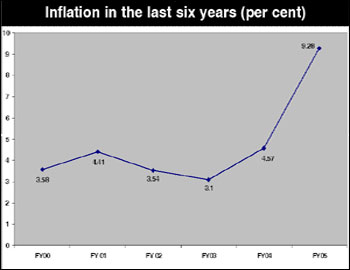 KARACHI, July 13: Inflation rose by 9.28 per cent in fiscal year 2005 as Pakistan’s economy grew faster than targeted and policy makers failed to kill inflationary expectations through timely moves.
Inflation measured by 374-item consumer price index went up by 9.28 per cent in fiscal year July-June 2004-05 against the target of five per cent, data released by the Federal Bureau of Statistics show. Inflation moved faster than targeted as the economy grew by an estimated 8.4 per cent against the initial target of 6.6 per cent.
A less-than required tightening of monetary policy and the government’s failure to ensure smooth supply of essential food items were also responsible for pushing up inflation in the last fiscal year. A year earlier when the economy had grown by 6.4 per cent inflation stood around 4.6 per cent only.
That both core inflation and food inflation showed faster increase in the last fiscal year than in the years earlier bring under question the role played by the State Bank and the government in controlling inflation. Core inflation rose by 7.62 per cent in the outgoing fiscal year whereas a year earlier it stood at 3.72 per cent. Similarly, food inflation more than doubled to 12.49 per cent in fiscal year 2005 from 6.01 per cent in fiscal year 2004.
The State Bank had initiated tightening of monetary policy since the start of the last fiscal year in July 2004 but it followed a gradual and measured tightening in the first three quarters of the year to facilitate higher growth. As a result, it failed to check inflation the way it should have and real negative lending rates encouraged hoarding of essential food items like wheat and sugar besides tempting businesses to build up unnecessary inventories or go for speculative investment in real estate and stocks. The combined impact of all this was that inflationary expectations continued to rise contributing to a higher-than-targeted inflation.
On the other hand, the government also failed in checking business malpractices like hoarding and cartel making — most prominently in wheat milling and sugar and cement manufacturing.
Mishandling of import of wheat and its distribution among the mills through provincial food departments also foiled the government move to stabilize prices of wheat flour. Pakistan had to import around 1.4 million tons of wheat in the last fiscal year to stabilize prices of wheat flour.
For the current fiscal year, the government has set the economic growth target at seven per cent and has vowed to keep inflation at eight per cent. It has also allowed import of essential food items including sugar by the private sector and is trying to keep a more vigilant eye on business malpractices to ensure a smooth supply of these items throughout the fiscal year. But public statements from senior government officials about enough sugar imports amidst a looming supply crisis of the commodity have frustrated the very purpose of the move — such statements despite enough sugar stocks in the country have led to hoarding of this commodity pushing up local prices.
On the monetary side, a real negative lending rate continues to encourage and facilitate hoarding and other such malpractices by businessmen. At the end of May this year, the weighted average lending rate of all the banks combined stood at 7.97 per cent — below the year-on-year consumer inflation of 9.84 per cent during that month.