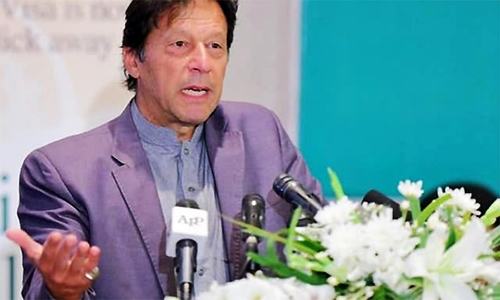
PRIME Minister Imran Khan appears to have developed a taste for offering meaningful insights on politics inside neighbouring countries.
This time, he has reflected on the Indian general elections that are due to begin today. Mr Khan has assumed that a BJP victory is more likely to boost chances of peace between Pakistan and India.
“Perhaps if the BJP — a right-wing party — wins, some kind of settlement could be reached,” Mr Khan remarked in an interview, adding that a government led by the Congress party might be too apprehensive of a possible backlash from right-wing elements to move forward on peace.
The Pakistani leader voiced his sentiment on the eve of an election which many Indian commentators say could unleash a new wave of narrow nationalism, ie Hindutva, in their country, with repercussions for the region and beyond.
At the same time, Mr Khan did acknowledge the massive alienation of the Muslim community in India, and in held Kashmir, and went on to criticise Prime Minister Narendra Modi and his BJP for practising the politics of fear.
Mr Khan’s views on the possibility of a right-wing party being more amenable to a settlement could well be based on the Pakistani experience of previous interactions with the BJP, including the visit of then prime minister Atal Behari Vajpayee who visited Lahore in 1999 — however, the bonhomie proved short-lived when the Kargil conflict erupted.
Again, in 2001, the right-wing BJP and Pakistan’s military president Gen Musharraf appeared close to a deal in Agra before hopes for a peaceful solution to the Kashmir dispute were thwarted.
The self-confessed architect of that fiasco, L.K. Advani, later faced the wrath of his own comrades of the Hindu right wing for praising Mr Jinnah.
But Mr Khan would do well not to raise his hopes, especially given Mr Modi’s record.
While there have been a few optimistic moments, such as Mr Modi’s visit to then prime minister Nawaz Sharif in Lahore, Delhi’s hostility to Pakistan has been rising under the BJP.
Snubs, complaints and threats have been par for the course, while the fear of war between the two nuclear-armed countries has still not dissipated after India’s unprovoked Balakot strike and Pakistan’s justifiable retaliation.
Meanwhile, the Congress party will hardly be pleased with Mr Khan’s billing.
The prime minister — a budding analyst who had only recently raised hackles, and many an eyebrow, with his overly candid views on an interim setup in Afghanistan — would do well not to make public statements that may be seen in a negative light and be construed as interference in a country’s internal affairs.
Times are sensitive, and Pakistan does not have good relations with either Afghanistan or India, both of which are in the midst of an uncertain period. A mature approach is needed by those at the top.
Published in Dawn, April 11th, 2019