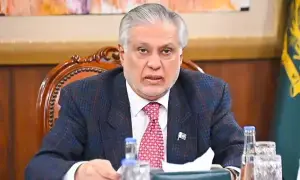
ISLAMABAD: Prime Minister Imran Khan on Thursday reaffirmed his government’s zero tolerance policy for militant groups as he chaired the first session of the National Internal Security Committee.
The agenda of the meeting was dominated by a review of progress on attainment of goals of the National Action Plan (NAP) on countering extremism and terrorism.
“Implementation of National Action Plan is the foremost priority of the present government as it is reflective of the will of the nation and is a consensus document agreed upon by all political parties of the country. The government is committed to removing all impediments towards implementation of the plan in letter and spirit,” Mr Khan told the participants of the meeting.
National Internal Security Committee decides to form expert working groups to ensure NAP implementation
The National Internal Security Committee is a new structure for deliberations on security matters. The composition of the newly formed body, which includes key members of the federal cabinet, chiefs of the Inter-Services Intelligence (ISI) and Intelligence Bureau, provincial chief secretaries and police chiefs, suggests that it has been created for inter-agency and inter-provincial coordination on security matters.
The role of coordinating and unifying national counterterrorism efforts was originally envisaged for the National Counter Terrorism Authority (Nacta) which has been in existence since 2009. The focal body for coordinating counter-extremism and counter-terrorism initiatives has, however, been unable to deliver on the desired objective. Resultantly, poor coordination between intelligence and law enforcement agencies and between the federal government and the provinces was endemic.
The first meeting of the new committee was held a day after PM Khan chaired a meeting on national security, which was participated by Finance Minister Asad Umar, Education Minister Shafqat Mehmood, Minister of State for Interior Shehryar Khan Afridi, Chief of Army Staff Gen Qamar Javed Bajwa, ISI Director General Lt Gen Asim Munir, Foreign Secretary Tehmina Janjua, Interior Secretary retired Maj Azam Suleman Khan and DG of the Inter-Services Public Relations Maj Gen Asif Ghafoor.
The government’s latest moves to make up for its shortcomings in its counter-extremism and counterterrorism campaigns come in the midst of renewed international pressure, particularly the Financial Action Task Force’s (FATF) review of the progress the country has made to strengthen its counter-terror financing and anti-money laundering regimes since being grey-listed by the illicit financing watchdog last year.
The Paris-based global watchdog had at its plenary session last month expressed dissatisfaction over the progress made by Pakistani authorities. A fresh review will be made by the FATF by May regarding compliance with the remaining targets on the basis of which it will decide in its June review meetings whether the country should be moved out of the grey list or kept in this list in case of minor shortcomings or downgraded to the black list.
A delegation of the Asia-Pacific Group (APG) on money laundering, a regional affiliate of the FATF, which visited Pakistan this week, has reportedly expressed serious reservations over insufficient physical actions on ground. The core issue revolves around inadequate action against groups proscribed as terrorist organisations.
Speaking at the meeting, Imran Khan recalled Pakistan’s sacrifices in the fight against terrorism and said that his government was “firmly committed not to allow any militant group to operate in the country or use its territory for any militant activity within or outside Pakistan”.
“Recounting various legislative and administrative measures taken by the present government in dealing with militancy, combating terror-financing, money laundering and hawala-hundi etc, the prime minister stressed upon the need for continued and sustained on-ground effort towards taking this struggle to a conclusive end,” the PM Office said in a statement on the meeting.
Finance Minister Umar briefed the participants about FATF-related matters and meetings held with the Asia Pacific Group delegation.
The interior secretary apprised the meeting about the progress on implementation of the NAP and highlighted efforts being made to deal with the issues of cyber security, money laundering, madressah reforms and address various challenges in way to successful implementation of the NAP.
The meeting decided to constitute expert working groups to ensure seamless coordination and implementation of every aspect of the NAP.
Published in Dawn, March 29th, 2019