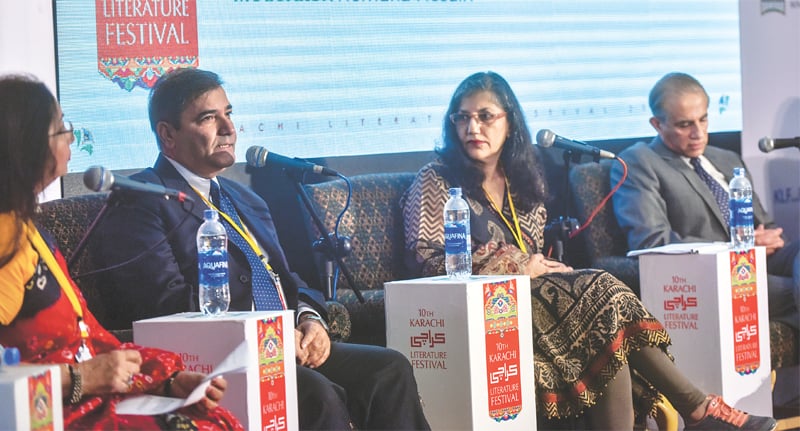
KARACHI: The first session on the topic of ‘The Karachi Dilemma’ moderated by Rumana Husain on Saturday, the second day of the 10th Karachi Literature Festival, generated a stimulating debate on the subject.
Ms Husain in her introduction said Karachi has been evolving since the British started to hold sway over it in 1838. The first panellist, novelist Maniza Naqvi, argued that it is not for the last 180-odd years that the city has been evolving, rather, its history can be traced to the time when Alexander the Great came down to the Indus River and one of his commanders reached the Karachi harbour where he kept his soldiers for the monsoons to pass. Ever since, the city has seen many a change in its name from Kolachi to Mai Kolachi to Karachi, and people from “elsewhere” have been populating it. It has had an immigrant experience. In the early 19th century, the British treated its harbour as a launch pad for war.
Architect Marvi Mazhar said she’d like to see the subject with a non-nostalgic lens. She’s learned from seniors such as Arif Hasan and Yasmeen Lari. One just can’t come up with a beautification plan for the city with a nostalgic framework. Karachi has to be a liveable city not a smart one.
Panellists point out there is no other city in Pakistan like Karachi
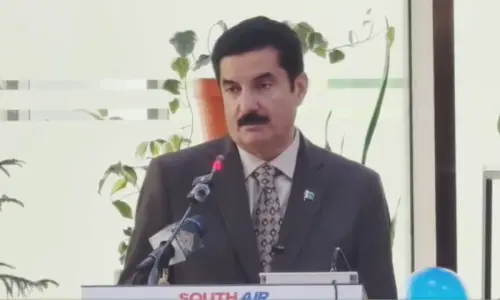
Metropolitan Commissioner Dr Syed Saif Ur Rehman said Karachi is a dilemma as a whole. One has to accept that there is no romance left in the city. To be romantic about it is to live in a fool’s paradise. Karachi is owned by no one. There are so many set-ups and no chain of command. There are many landholdings, metropolitans, six cantonments etc. Karachi’s situation will not improve unless we have a chain of command.
Dr Rehman said Karachi is not confined to district South. All our beautification plans seem to be focused on district South from the port to Numaish, whereas a vast majority of Karachiites live in West and East districts. Instead we concentrate on areas that are marked by their colonial buildings.
Amir Zia said in a city of a population of 25 million, three million to four million people commute daily from the outskirts. We need to understand that because of its diverse population there is no other city in Pakistan like Karachi. It has an equal population base of Pathans and Urdu speakers, as well as people from other parts of the country.
Marvi Mazhar disagreed with Dr Rehman saying that the real problem is one of administration.
Published in Dawn, March 3rd, 2019