Nawaz approaches SC for bail on medical grounds


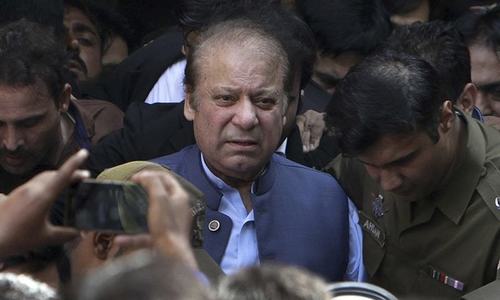
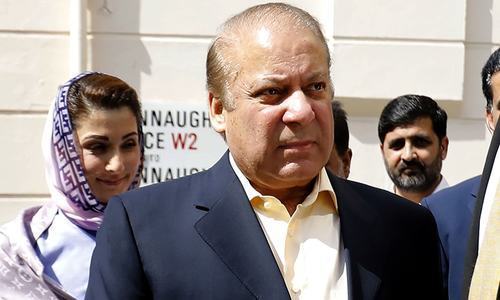
ISLAMABAD: Four days after the rejection of his bail plea, former prime minister Nawaz Sharif approached the Supreme Court on Friday to seek the overturn of the Feb 25 order of the Islamabad High Court (IHC) dismissing his petition on medical grounds in the Al-Azizia corruption case.
Moved through his counsel Khawaja Haris Ahmed, the incarcerated former premier pleaded before the apex court that his release be ordered on bail after treating the petition at hand as an appeal and suspend the execution of the Dec 24, 2018, sentence of seven years’ imprisonment awarded by Accountability Court No II.
In its order the high court had held that none of the medical reports about Mr Sharif’s condition suggested that his continued incarceration would in any way be detrimental to his life, adding that he had been hospitalised time and again since January 2019, whenever he made complaints about being indisposed.
“In fact the reports of [a] board of doctors and various teams constituted are indicative of the fact that [the] petitioner is receiving [the] best possible medical treatment available to any individual in Pakistan,” the judgement held.
In his plea, the counsel says former premier’s life is at stake
However, in his petition, Mr Sharif argued that notwithstanding his conviction and his consequent imprisonment, he retained the right to have medical treatment conducted by the practitioner of his own choice. Therefore, his counsel argued, the Feb 25 IHC order was in violation of his fundamental right to life as guaranteed by Article 9 of the Constitution, adding that the Pakistan Prison Rules, 1978, were neither relevant to nor were invoked by him for the suspension of his sentence on medical grounds. As such, any reference to police rules or their non-applicability to his case was redundant and extraneous to his plea for the suspension of sentence, it was argued.
The petition highlighted the diagnosis recorded in the medical reports of the Special Medical Board (SMB), constituted of experts from different hospitals, that suggested that Mr Sharif was suffering from recurrent angina, ischemic heart disease, coronary artery disease, diabetes, hypertension, chronic kidney disease at stage three, diabetic nephropathy, dyslipidemia, and hyperuricemia.
The SMB also recommended unanimously that Mr Sharif requires 24-hour monitoring in a multidisciplinary facility for managing his ailments and that he required angiography after clearance from nephrologists and cardiac surgical back-up for ascertaining what further management and treatment he may need, the petition recalled, given his past medical history that involves 15 years of multiple hospitalisation. But, the petition argued, the high court failed to exercise jurisdiction vested in it by law in passing the Feb 25 judgement without adverting to the particular facts pertaining to Mr Sharif’s medical condition, despite noting the principle – as laid down in the 1997 Muhammad Arshad case – that in cases involving the suspension of sentence on medical grounds, the facts of each pieces of litigation have to be assessed on their own merits. The petition further argued that the high court committed a ‘grave jurisdictional error’ in basing its judgement on the premise that in none of the medical reports of the SMB was any mention that Mr Sharif’s continuous incarceration will be life-threatening. In any case, when the special boards had recommended that he needed round-the-clock medical/cardiac monitoring or hospitalisation, that was sufficient to establish that continued incarceration was inevitably detrimental to his life. Further, it was argued, that the high court order derogerates principles governing the grant of a bail/suspension of a sentence laid down by the Supreme Court, the petition contended.
The medical reports pertain only to a diagnosis showing that Mr Sharif is suffering from various ailments, which collectively constitute a risk for stroke, an alarming degree of threat of irreversible damage to his heart and potential threat to further deterioration of other ailments, said the petition.
Published in Dawn, March 2nd, 2019