

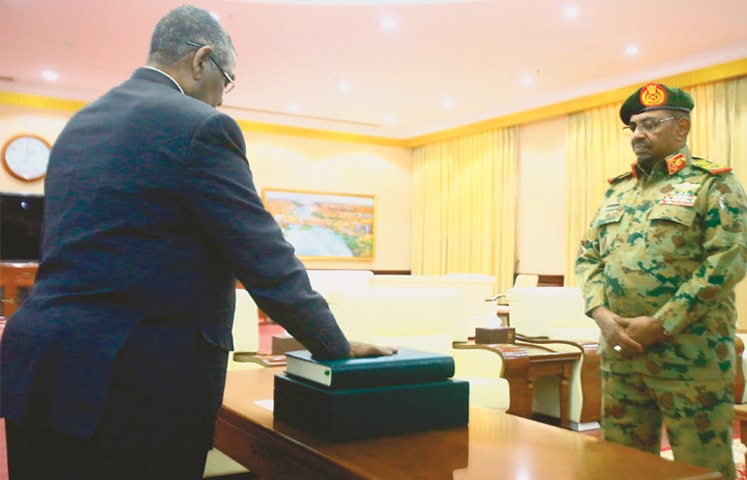
KHARTOUM: Hundreds of protesters rallied on Sunday against Sudanese President Omar al-Bashir’s decision to impose a nationwide state of emergency, as the longtime leader swore in a new prime minister.
Bashir declared a year-long emergency on Friday after a deadly crackdown failed to suppress weeks of protests that have rocked his three-decade rule.
The president, who swept to power in an Islamist-backed coup in 1989, also dissolved the cabinet and provincial governments, and pledged to bring in technocrats to help end the economic crisis — the key factor behind the protests.
But on Sunday demonstrators rallied against his latest measures and confronted riot police in the capital Khartoum, its twin city of Omdurman, and in the town of Madani, witnesses said.
“We want to give the president a message that the state of emergency will not deter us,” said Sawsan Bashir who participated in the Omdurman rally.
“Our aim is to overthrow this regime and we will do it.” Analysts said the state of emergency was an act of desperation in the face of public anger, and a more violent confrontation between security forces and protesters could not be ruled out.
Protesters also demonstrated in the capital’s districts of Burri, Shambat, Street 60 and Al-Mamura, witnesses said.
“In Burri, protesters are even checking identity cards of anyone who is coming into the neighbourhood,” a resident from the area said.
Onlookers reported thick smoke billowing into the sky in Burri, with protests setting tree trunks and tyres ablaze and blocking roads with rocks.
About 300 people rallied in Al-Mamura, an upmarket area of businessmen and traders, witnesses said.
Riot police in Khartoum and Omdurman responded with tear gas, witnesses said.
Hundreds of protesters also gathered in Madani, south-east of the capital, where they were confronted with tear gas, witnesses said.
“Protesters are burning tyres, tree trunks and blocking roads in some neighbourhoods of Madani,” a resident from the town said.
Even as protests continued, Bashir swore in a new premier, vice president and governors for the country’s 18 provinces on Sunday.
Former governor of the agricultural state of Jazeera, Mohamed Tahir Eila, was sworn in as the new prime minister at a ceremony in the presidential palace.
“We hope we can offer job opportunities to our youths so that they can achieve their aspirations,” Eila told reporters after he was sworn in.
Sudan’s defence minister, General Awad Ibnouf, took on the additional role of first vice president, after his predecessor Bakri Hassan Saleh was sacked by Bashir.
Published in Dawn, February 25th, 2019


























