Murad to call for revisiting distribution criteria in NFC meeting today


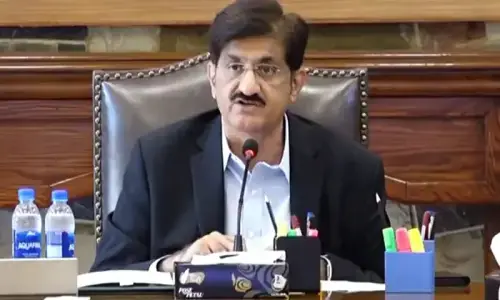
KARACHI: Sindh Chief Minister Syed Murad Ali Shah will be leaving for Islamabad on Wednesday (today) to participate in the maiden meeting of the National Finance Commission for finalising the 10th NFC award.
Officials said he would press the need of revisiting the NFC criteria for distribution of resources from the federal divisible pool and on Tuesday he gave final touches to his talking points.
Besides the chief minister, expert Asad Sayeed would also participate in the meeting as a nominee of the Sindh government in the recently reconstituted commission.
Besides raising the NFC criteria issue, the chief minister would also take up the shortfall of Rs104 billion in the head of federal transfers from the divisible poll during the last seven months.
The main emphasis of the CM will be on increasing the ratio of weightage from population to performance and revenue generation, collection of tax by the Federal Board of Revenue on wholesale and retail sales; sales tax on goods be assigned to the Sindh Revenue Board on behalf of the FBR and retain service charge.
He would also suggest that the capital gains tax (CGT) on immovable property which used to be collected by the federal government should be devolved to the provinces in the spirit of the 18th Amendment.
He would also argue on the need to set up a joint committee of federal and provincial governments with international experts for rationalisation of federal and provincial tax collection; broadening the tax bases at both levels; eliminating duplicate taxation and study on revenue generation at the federal and provincial levels.
Likewise, he would also urge the need to transfer the Gas Infrastructure Development Cess to the provinces as it was a provincial subject.
He would also demand that the Sindh government be given its due share from the amount collected by the federal government under the GIDC so far.
Similarly, the excise duty on crude oil and natural gas as per Article 161 of the Constitution needed to be devolved to the provinces and its rate be enhanced because in the 7th NFC award it was fixed at Rs10 per MMBTU which should be charged ad valorem.
The other pressing points include that the federal government collects royalty on crude oil/natural gas and charges two per cent of the receipts as collection fee but now, the provinces should be allowed to collect that tax themselves.
The Octroi and Zila Tax (OZT), which was a consumption tax with 46 per cent Sindh’s share, was dissolved and instead the rate of sales tax was enhanced from 12.5pc to 15pc and the extra 2.5pc levy was used to compensate the provinces.
The federal government in 2010 started transferring funds in lieu of the OZT on the basis of the criteria governing the NFC award — population, etc — which reduced Sindh’s share to 0.66pc as such Sindh’s share of OZT need to be enhanced to at least 2pc.
Sindh would also discuss that the provinces should be consulted while granting concessions, reducing sales and other taxes on a particular industry, waiving or changing tax rates.
The chief minister would also oppose the federal government suggestion to make 7pc of the total divisible pool as part of a special pool for social sector and expenses on security because Khyber Pakhtunkhwa was allowed an additional 1pc share on account of its losses in the war against terror.
The Sindh government would plead that most of the terrorists moved to Karachi, forcing the provincial government to enhance manifold its expenditure on security.
Published in Dawn, February 6th, 2019