Politicians welcome CJP’s call for dialogue


ISLAMABAD: Leaders of the country’s three main political parties have cautiously welcomed the call of new Chief Justice of Pakistan Justice Asif Saeed Khosa for holding an “intra-institutional dialogue aimed at framing a charter of governance”, but also sought clarity on its details.
A number of senior leaders and office-bearers of the Pakistan Tehreek-i-Insaf (PTI), Pakistan Muslim League-Nawaz (PML-N) and the Pakistan Peoples Party (PPP), when contacted to seek their comments on the CJP’s proposal, said they could not speak on behalf of their respective parties since the issue had so far not been deliberated upon at the party level. While cautiously welcoming the CJP’s suggestion, they said that such an idea had been floated by various personalities and leaders in the past too, but no one took the initiative to materialise it.
Speaking at a full court reference held in honour of former CJP Mian Saqib Nisar last week, Justice Khosa had proposed an inter-institutional dialogue for developing what he called a charter of governance, saying that they had reached “a stage in our national life where we must take stock of the mistakes committed in the past and come up with a charter of governance to ensure that such mistakes are not repeated”.
“I would request the worthy president of Pakistan to convene a meeting and to chair the deliberations which should also be attended by top parliamentary leadership, the top judicial leadership and the top executive leadership, including the military and the intelligence agencies,” he had suggested.
“After bringing all major stakeholders in national governance to one table, efforts should be made to heal the wounds of the past, attend to the sore points and work out a practicable policy framework where every organ and institution of the state exercises its powers and performs its functions within its constitutionally defined limits,” Justice Khosa had proposed, adding that the sole purpose of the inter-institutional dialogue should be to bolster constitutionalism and rule of law, strengthen democracy and create an environment where the state and all its organs and institutions may be able to devote their wholehearted attention to the real issues of the citizens.
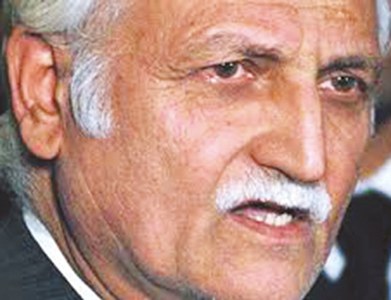
“CJP Khosa has uttered some very fine, laudable (and) inspiring words. However, we have heard such great words before also but later disappointed,” writes PPP secretary general Farhatullah Khan Babar on his official social media account on Twitter on Sunday.
“Welcome laudable words, applause after words translated into actions. Welcome expressions of pious intentions, applause only after actions,” he concludes.
It was former Senate chairman Raza Rabbani who had floated the idea of holding intra-institutional dialogue for the first time. Addressing a national seminar in Quetta in August 2017, he had underlined the need for developing a consensus on a framework under which all state institutions worked within the domain of the 1973 Constitution and offered them the platform of the Senate for dialogue on constitutional issues in this regard.
Later, while presiding over the Senate sittings, he had repeatedly stated that the Constitution had determined the parameters for all state institutions and they must work under these boundaries. According to Mr Rabbani, parliament is the weakest institution in the country as in the past it was not allowed to function by imposing martial law and using the notorious Article 58-2(b) and “now new tactics are being used to defang it”.
When contacted to seek his comments on the new CJP’s remarks, Mr Rabbani said he believed that instead of the president, the forum of parliament should be used for initiating such a dialogue among all state institutions. He explained that the Presidency had a “baggage” with it as in the past it had played a major role in the country’s politics and with the insertion of Article 58-2(b) in the Constitution, it had become the centre of politics. He recalled that there was a time when a term “troika” was used frequently for the president, prime minister and army chief.
Moreover, Mr Rabbani said, he was opposed to the idea of giving any role to the Presidency in the holding of such dialogue against the backdrop of an “ongoing campaign” to discredit parliament and introduce a presidential form of system in the country. The PPP stalwart said the complex problems being faced by the country could only be solved through intra-institutional dialogue.
Similarly, PML-N spokesperson Marriyum Aurangzeb also welcomed the idea of holding intra-institutional dialogue, but said the “Constitution should be the driving force”.
Former prime minister Shahid Khaqan Abbasi, while talking in a TV talk show recently, also called for a dialogue among all institutions to steer the country out of the present political mess.
On the other hand, Leader of the House in the Senate Shibli Faraz of the ruling PTI said the CJP’s remarks required some elaboration as presently all institutions were already on one page. However, he said that he personally thought that the country was still not running the way it should be.
He said that holding of a national dialogue was not a bad idea and the government was ready to take every step which would make the country progressive, democratic and prosperous. He endorsed the CJP’s views that the president should take the initiative of intra-institutional dialogue as the latter was a part of parliament.
Published in Dawn, January 21st, 2019