I do not remember if anyone seriously thought of starting a campaign to save Karachi’s old buildings till Hameed Haroon asked Ghazi Salahuddin and me to team up to highlight the need for conservation of the city’s architectural heritage in The Star. The occasion was a dinner at the Garden East residence of Mumtaz Rashdi. This was early 1983 — 35 years ago.
It was decided that Ghazi would write the text and I would photograph the buildings. We titled the campaign “Vanishing Karachi” and it ran on the back page of the eveninger The Star every Thursday during 1983 and 1984. In those days, The Star had a galaxy of passionate journalists: Zohra Yusuf and her colleagues, the dear departed souls Saneeya Husain, Ameneh Azam Ali, Vai Ell and Kaleem Omar. Other writers, such as Nusrat Nasrullah, Saher Ali, and my late friends Anwar Enayatullah, Hameed Zaman and Sultan Ahmad, too, picked up their pens and wrote in Dawn, Morning News, The News and Leader. Editorials appeared in various papers highlighting the importance of heritage for any civilised society.
I remember that Qazi Faez Isa, (I think he had not yet become a judge) on behalf of Shehri (Citizens for a Better Environment), appealed to the Karachi Development Authority to save Ispahani Building on McLeod Road (now I.I Chundrigar Road) from Muslim Commercial Bank (now MCB) getting ready to demolish it. (Alas! The building could not be saved).
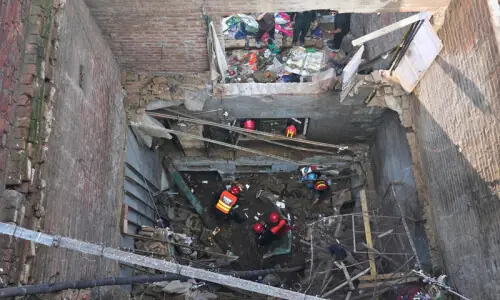
Despite a multitude of art lovers in the city, Karachi’s architectural heritage is slowly disappearing
‘The Vanishing Karachi’ series in The Star was followed by other activities of our advertising agency Oscar; a 12-page wall calendar and picture cards were designed and sponsored by Pakistan Cables Limited; exhibitions of photographs of old buildings were held at Pakistan American Cultural Centre, Karachi American School and the Karachi Arts Council. Later, I published a coffee-table book of my photographs titled Vanishing Karachi, with a foreword by Zohra Yusuf. Framed images of these buildings adorn the walls of Sindh Institute of Urology and Transplantation (SIUT).
I may quote from its foreword: “… all the statues that once adorned the Frere Hall grounds, including one of Queen Victoria, were removed and dumped in a KMC godown [warehouse] (the removal of these statues from all public places had started as early as in 1949-50) … There is a lot disappearing in Karachi … street names that were once a part of the city’s history now changed in a denial of the past … consigning the contribution of the city’s non-Muslim forefathers to the dustbin of history … The multi-culturalism that once defined Karachi has also vanished with its architectural heritage … Our history textbooks fail to acknowledge the contribution of the Goans, Parsis and Sindhi Hindus, the original guardians of this city — from philanthropy to education, to the arts and architecture ...”
I would also like to quote, from the above book, my own lamentation: “With arms folded we have watched from the sidelines, the destruction of some of the most beautiful old buildings of our city: Palace Hotel on Club Road, Bliss & Company on Elphinstone Street (now Zaibunisa Street), Chopsy Building at Pakistan Chowk, Jehangir Kothari Building on Victoria Road (now Abdullah Haroon Road, Victoria Furniture on Dandas Street, all the cinema houses — Paradise, Capitol, Rex, Palace, Mayfair, Plaza, Naz, Nishat, Taj Mahal, Light House, Regal and others — in addition to many old mansions, offices and residential houses in Bath Island, Clifton, Saddar, Civil Lines, Parsi Colony and other areas of the old city.”
Another book worth mentioning in this regard is Karachi: Legacies of Empire by Peerzada Salman published in 2015, comprising articles on Karachi’s colonial buildings that he wrote for Dawn for four years.
A few buildings survived due to the efforts of some individuals and organisations, such as the Mohatta Palace, Flag Staff House, State Bank Library — and, of course, that remarkable feat of transporting the Nusserwanji building from Kharadar, brick-by-brick, and creating the Indus Valley School of Art and Architecture in Clifton. Recently the Karachi Press Club building has also been renovated by the Endowment Fund Trust, saving further dilapidation of the heritage building.
Some buildings survived by default, on account of their occupation by organisations out of bounds for the common man: Victoria and Albert Museum by the Supreme Court, Jinnah Courts and Mitharam Student Hostels by the Rangers, Hindu Gymkhana by NAPA. But the others surviving, such as the Ghulam Hoosain Khalikdina Hall, the D.J. Science College, the Freemason Hall, the Eduljee Dinshaw Dispensary and the Merewether Tower need to be made presentable and maintained. Needless to say, many old buildings in areas such as Saddar, Bunder Road (now Mohammed Ali Jinnah Road), Pakistan Chowk, Frere Road (now Shahrah-i-Liaquat), etc., are being subjected to slow death in order to make room for shopping and residential complexes.
Having said that, I still fail to understand what keeps the rich corporations or the wealthy citizens of this mega city from owning these architectural wonders? If these were not suitable for business purposes, they could be transformed into museums and art galleries. There is no shortage of art lovers in this city. So, what is it that holds them back to invest in the restoration and conservation of these buildings? Is it some kind of malignant insensitivity and absence of good taste that makes the affluent fellow citizens blind to things beautiful?
The writer is an amateur photographer and singer, trained in classical music by Ustad Wilayat Ali Khan
Published in Dawn, EOS, January 6th, 2019