Supreme Judicial Council directs LHC judge to present money trail of offshore properties



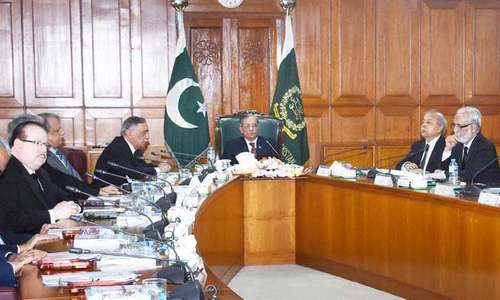
The Supreme Judicial Council (SJC) on Thursday resumed the hearing into a complaint of misconduct lodged against Justice Muhammad Farrukh Irfan Khan of the Lahore High Court.
Justice Irfan is facing the reference on misconduct after his name surfaced in the list of those having properties abroad in the 2016 Panama Papers leaks. He was issued a show-cause notice by the SJC in February 2017.
The council is the only constitutional forum invoked under Article 209 of the Constitution for removing superior court judges.

Headed by Chief Justice Saqib Nisar, the five-member SJC took up the reference against the judge after accepting his application seeking a public trial of the case pending adjudication against him.
The prosecution lawyer informed the council that the regional tax officer had issued a notice to Justice Irfan for allegedly not declaring an offshore company in his tax returns.
Also, a representative of the Securities and Exchange Commission of Pakistan (SECP) while appearing before the council presented the record of five companies held by the judge in Pakistan.
"It has been recognised that the judge set up the companies," remarked Justice Nisar, the SJC chairman, adding that foreign properties had been purchased through offshore companies.
"Where did the money come from to purchase the property abroad?" the top judge questioned. He also inquired whether the funds had been earned abroad or transferred from Pakistan.
"The judge has to explain the money trail himself [... and] be answerable for his purchase of properties abroad," Justice Nisar stressed.
After Regional Tax Officer Sarmad Qureshi presented Justice Irfan's tax returns before the council, Advocate Hamid Khan, who was representing the judge, argued that the SJC had asked for tax returns from the years 2010, 2011 and 2012.
The SJC, however, dismissed Advocate Khan's objection after the prosecution lawyer stated Justice Irfan's tax returns beyond 2010 were available on record.
The prosecution lawyer revealed that Qureshi had brought with him the judge's tax returns from 2001 and 2002, along with records of his wealth tax. Justice Irfan had not filed tax returns between 2003 and 2006, he added.
After hearing the officials, the SJC allowed Justice Irfan's lawyer until the next hearing to present records showing his money trail. The hearing of the reference was adjourned until January 8.