0
0

ISLAMABAD: Sectarian appears not just in the form of violence but also in people’s group-thinking, and in order to eradicate it, there is need to promote a culture of learning to live with differences even if one does not agree with them, participants of a seminar on Wednesday said.
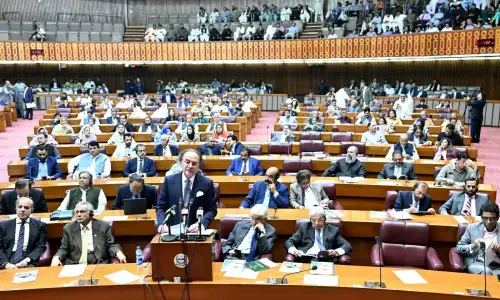
The day-long seminar, titled ‘Understand the Sectarian Dynamics in Pakistan’, was organised by the Pak Institute of Peace Studies (Pips) and attended by around 30 experts.
The dialogue noted that sectarianism has become a major ailment in the country. Pips’ research also showed a strong connection between sectarianism and militancy, which they referred to as ‘flesh’ and ‘blood’.
In addition to sect-based outfits, militant groups are also deeply sectarian in nature and this comes forward time and again in their targets and their language.
Researcher Safdar Sial noted that sectarian violence had declined gradually over the years, and while this is positive, there has been a worrying gradual ingress of sectarian and faith-based discrimination in individuals’ attitudes and behaviours in Pakistan.
Pips Director Mohammad Amir Rana agreed that the issue is greater than just sectarian violence, saying that group-thinking on sectarian lines is commonly observed in different segments of society.
Such thinking, particularly in professional lives, hampers productivity, he said. This is why social cohesion is marked as one of the indicators of progress the world over.
Former Council of Islamic Ideology (CII) chair Dr Khalid Masud said the problem is the descent of those differences into violence.
He hinted that sectarianism in Pakistan evolved into modern-day terrorism, rather than the other way around. He said the Western distinction of the world was borrowed before and after 9/11, even though Pakistan began facing sectarian violence in the 1980s.
German Ambassador Martin Kobler, speaking at the seminar, said that almost half a century ago Europe too was facing sectarian conflict. He said Europe learned from its mistakes, overcoming the bitterness of the past, adding that tolerance was about living with differences one may not necessarily agree with.
“Tolerance hurts,” he said, but accepting to live with it is the way forward. One of the ways is to realise a single person has multiple identities based on gender, faith, ethnicity, likes, dislikes and so on.
CII Chair Dr Qibla Ayaz said the role of the state comes into any debate on curbing sectarianism in the country, but as of now it is important to understand that all state institutions back the Paigham-i-Pakistan, which denounces violence.
Participants praised the government for emphasising sectarian harmony in the National Action Plan by calling for a crackdown on hate speech, taking action against religious extremism and regularising and reforming madressahs.
Academic Dr Khadija Aziz argued that the differences have been aggravated to the negative with the advent of modern technology, which should also be analysed. She said to some, sect-based differences reflected diversity, as much as of other identities.
Published in Dawn, December 20th, 2018