Baloch separatist leader Harbiyar Marri among 13 booked for Chinese consulate attack



As the investigation into Friday’s attack on the Chinese consulate in Karachi made headway on Saturday, police officials suspected Harbiyar Marri, the exiled leader of the banned Balochistan Liberation Army (BLA), of being the mastermind of the deadly assault that left two policemen and as many civilians dead.
Police officials say the attack, carried out with the assistance of Indian intelligence agency Research and Analysis Wing (RAW), was an attempt to strike against the growing diplomatic and economic relations between China and Pakistan.
In a case registered by the Sindh police’s Counter Terrorism Department (CTD) against Marri and 12 of his aides, including BLA commander Aslam 'Acchu' alias Miraq Baloch, investigators said their initial findings had shown that the attack was "a failed and shameful attempt to harm the Pakistan-China relationship".
According to the first information report (FIR) registered by CTD police on behalf of the state through Boat Basin Station House Officer under charges of murder and terrorism, etc., “BLA accepted the responsibility for the attack and identified three slain militants along with their pictures as Azal Khan Baloch, Razik Baloch and Rais Baloch.”
“The BLA is supported by Indian agency RAW,” reads the application written by SHO Boat Basin with the FIR.
The 13 masterminds and facilitators of the attack as listed in the FIR include Harbiyar Marri, Aslam alias 'Acchu', Bashir Zeb, Noor Bux Mengal, Karim Marri, Capt Rehman Gul, Nisar, Gaindi, Sheikhu, Sharif, Hamal, Munshi and Agha Sherdil.
According to the FIR, the militants involved in the attack remained in continuous touch with the said persons during the assault.
Apart from explosive material, arms and ammunition, a BLA flag was also recovered from the possession of the three killed militants.
Investigators revisit crime scene
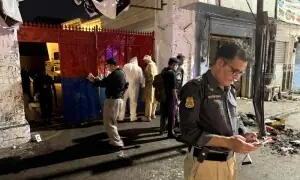
CTD investigators on Saturday revisited the crime scene at the Chinese consulate.
Raja Umar Khattab, a CTD officer who is supervising the probe told Dawn that the purpose of the visit today was to assess as to how the attackers reached the consulate, who put up resistance and why several vehicles were burnt or damaged.
Khattab said after ASI Ashraf Dawood and constable Mohammed Amir were martyred at the first check-post by the attackers, all security personnel posted at the foreign mission became alert.
One police constable identified as Akram took position and opened fire on the militants, as a result of which one of the attackers sustained a critical bullet wound on his abdomen. The militant then took shelter at a wall of a nearby bungalow where he died due to excessive bleeding.
Two of his accomplices resorted to heavy firing and threw hand grenades as they managed to enter the reception room of the visa facility, where at least nine people, including a woman, were present. The woman immediately shut the door of the visa section and went inside while a guard locked the main armoured gate.
In an attempt to break open the armoured gate, the militants resorted to heavy firing, leaving two visa applicants Niaz Muhammad, 55, and his son, Zahir Shah, 25, dead.
They also tried to open the armoured gate with help of C-4 explosives but did not succeed, the CTD official said. The two militants were then gunned down by security personnel.
The heavy firing and hand grenades thrown by the two attackers, ostensibly in a state of panic, damaged two police vehicles, one armoured personnel carrier (APC) and six other cars parked outside the consulate. Three of the cars caught fire due to the grenade blasts.
Officer Khattab told Dawn "some arrests" have also been made in the case but that it would not be appropriate to share details with the media at the moment.
He said one slain militant, Razik, had been identified through fingerprints while the fingerprints of the other two attackers had not matched with National Database and Registration Authority (Nadra) records, indicating that they had not had their CNICs made.