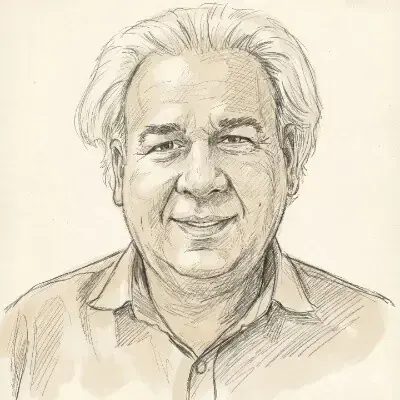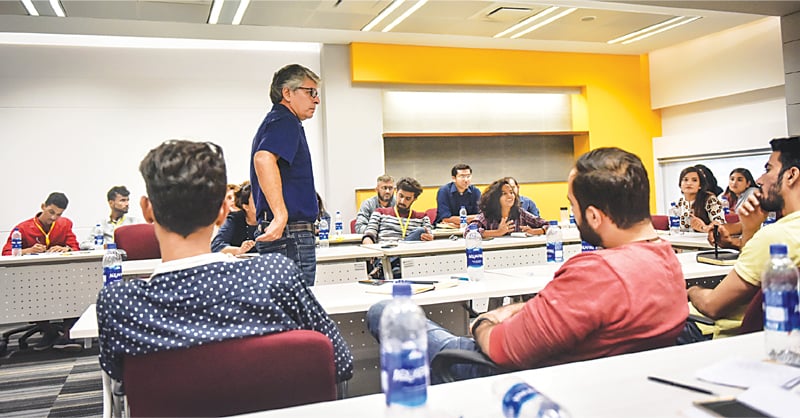
KARACHI: What happens when you enter a room and see some young boys and girls eagerly watching a scene from the Oscar-winning film Kramer vs Kramer? Of course, the answer is, you quietly sit down in one corner of the room and see why the scene is being shown. This happened on Wednesday evening at IBA City Campus as part of a special session where Indian film-maker and screenwriting instructor Ashwini Malik was giving valuable information to a group of aspiring film-makers on the art of writing screenplays. He has been conducting a workshop in the city for the past few days on the invitation of the Karachi Film Society (KFS).
Back to Kramer vs Kramer. It was the famous kitchen scene from the film in which Ted Kramer (Dustin Hoffman) is trying to cook breakfast for his son Billy (Justin Henry) because his wife Joanna (Meryl Streep) has left him. Malik’s topic was writing, that is, how a writer (in this case Robert Benton) constructs a scene to illustrate a point and how he uses certain objects to enhance the effect of the situation.
Malik emphasised on the choice of a seemingly natural ‘event’ in a sequence which the writer subsequently made into a ‘dramatic event’ in order to tell the viewer that Ted’s character feels lacking in raising the kid by himself.
From that point Malik turned his attention to ‘objects’ within a natural environment. In that context he gave the example of objects available in the kitchen, such as cups, a coffee-maker, juice boxes and a frying pan. And since the protagonist, Ted, is a strong character, he’s not giving up on making breakfast despite not being familiar with the process. The writer keeps coming up with stuff that underscores his inability to cook food.
Malik also told the youngsters about the turning points in the scene: one, where the egg (used for breakfast) breaks in a clumsy manner and the conflict begins; two, it goes towards resolution when the child screams, ‘Daddy, it’s burning, it’s burning.’ So, it remains to be seen for how long Ted manages to carry on with the effort. In the next scene, it’s shown that the father doesn’t even know which class his child is in.
Highlighting this point, Malik claimed that the writer touched on topics which to date were relevant — divorce, role of women in society, chauvinism, how men are not equipped to do certain things etc, because the story of the film is about a certain milieu.
After the presentation, the floor was opened for a question-answer round. Replying to a question about the process of writing scripts, Malik said there was no fixed process. Some writers come up with the treatment of the story first, others write down scenes. Indian film-maker Govind Nihalani, for example, wants to begin his stories with an image.
After the session, a certificate-distribution ceremony was lined up for those who had attended the workshop.
Published in Dawn, November 9th, 2018