Quality of result management improved significantly in by-polls: Fafen


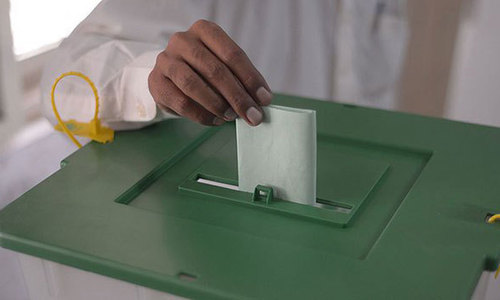
ISLAMABAD: The Free and Fair Election Network (Fafen) has observed that the quality of election result management significantly improved in the recent low-turnout by-elections held in 35 constituencies of national and provincial assemblies.
“While a considerable decline in the turnout in these constituencies as compared to July 25, 2018 is disconcerting, the transparency and efficiency of vote counting at the polling stations and tabulation of the provisional results by the Returning Officers (Form-47-Provisional Consolidated Statement of the Result of the Count) was encouraging, improving the overall credibility of the electoral process,” says a report released by Fafen on Tuesday.
Women’s turnout remained above legal threshold of 10pc in all constituencies
Provisional results for all of these constituencies were finalised by the 2am deadline as stipulated by Section 13 (3) of the Elections Act, 2017, with the exception of PB-40 (Khuzdar), it points out.
This demonstrable improvement coupled with strengthened enforcement of voting processes also correlates with Fafen’s long-term finding drawn from the observation of over 100 by-elections held between 2008 and 2018 that election quality is enhanced when the exercise is managed directly by the Election Commission of Pakistan (ECP) officials as district returning officers (DROs) and returning officers (ROs), in comparison to elections managed by officials employed from the lower judiciary for this purpose. For by-elections, the ECP appointed regional election commissioners as DROs and district election commissioners as ROs, except for PP-164 (Lahore-XXI) where the deputy director (local government) was given the responsibilities of RO.
Fafen deployed 1,737 election day observers — 1,296 men and 441 women — who observed the voting and counting processes at 4,038 polling stations in 11 National Assembly and 27 provincial assembly constituencies (13 in Punjab, nine in Khyber Pakhtunkhwa and two each in Balochistan and Sindh).
Elections in PP-296 (Rajanpur-IV) and PP-87 (Mianwali-III) were uncontested. However, polling took place in the remaining 35 constituencies.
Nearly 54 per cent less women and 44pc less men turned out to cast their vote for National Assembly constituencies during the by-elections in comparison with the 2018 general elections.
However, women’s turnout remained above the legal threshold of 10pc in all the constituencies. The turnout for NA constituencies declined from 51.9pc to 26.5pc, for Punjab PA constituencies from 57.8pc to 43.7pc, for Khyber Pakhtunkhwa PA constituencies from 45.4pc to 21.7pc and for Sindh PA constituencies from 50.9pc to 36.8pc.
A total of 374 candidates ran for 35 constituencies. Of these, 139 candidates represented 27 political parties, while 235 contested independently.
The ECP had set up 7,489 polling stations comprising 21,783 booths for 9,283,074 registered voters in the 35 constituencies, averaging 1,239 voters per polling station and 426 voters per booth.
The by-elections witnessed an increased number of registered voters on the electoral rolls — 42,810 voters (18,540 men and 24,270 women) — in comparison with July 2018 general polls.
Nearly 1pc Fafen observers had been restricted from observing the voting process and around 6pc from the counting process. The Fafen observers reported a relatively lesser number of illegalities and irregularities during the voting process observed at 3,994 polling stations where they were allowed observation.
The right of voters to secrecy of the ballot was breached at 146 polling stations where the polling staff did not stop unauthorised persons from accompanying them behind secrecy screens. At 848 polling booths, secrecy screens were set up in a way that voters could be seen marking their ballots.
As many as 95pc of the presiding officers interviewed by the Fafen observers said they were trained by the ECP and had the required understanding of using the Results Transmission System (RTS) and 95pc of presiding officers successfully transmitted the results through RTS.
The Fafen observers reported 27 incidents of violence, albeit minor, inside and outside the polling stations.
Published in Dawn, October 17th, 2018