Irsa calls for building two mega dams to address growing water challenges



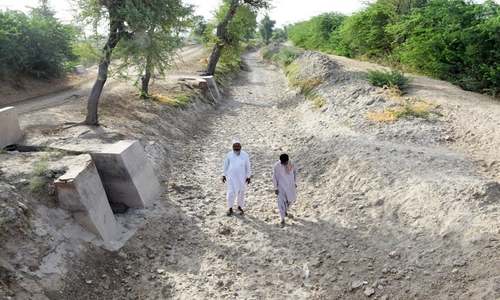
ISLAMABAD: The Indus River System Authority (Irsa) on Tuesday anticipated 35-40 per cent shortfall of irrigation water in Rabi season beginning Oct 1, and advised the government to start working on building at least two storage reservoirs to address the increasing future challenges.
This was concluded at a meeting of Irsa’s technical committee presided over by Director Operations Khalid Idrees Rana and attended by representatives of the provinces, Wapda and Meteorological Department.
All the stakeholders submitted their estimates for the overall water availability for the upcoming cropping season that ranged between 35-40pc. Mr Rana told Dawn that Irsa would now work out average water availability on the basis of stakeholders’ estimates.
A working paper would be submitted to the advisory committee that is scheduled to meet on Monday, to finalise water availability projections and distribution plan for provinces. Advisory committee is led by chairman Irsa and comprised all the four provincial members.
Estimates 40pc water shortfall for Rabi crops
He said the water situation was critical. However, any western wave could bring rainfall in Dec-Jan period which may lower the shortages. Responding to a question, he said the water shortage in Rabi season at 49pc was the highest in 2001-02 in the recent history when the country achieved a bumper wheat crop as overall weather conditions turned conducive.
The water shortage stood at 36pc during the last Rabi and wheat production again touched 25.4 million tonnes, slightly below the output target.
Mr Rana said that the climate change conditions are getting serious each year, making it difficult for the authorities to firm up the water availability anticipations correctly. He said the continuous water shortages had a long term negative impact in terms of increasing stress on water table because of the greater reliance on groundwater extraction.
The farmers start relying more on groundwater extraction through tube wells to meet their crop requirements when canal water availability is below normal which also increase the output costs. He said it was also getting difficult for the authorities to manage groundwater extraction in the absence of any law.
He said that the authority believes the country needs at least two mega dams in addition to under process, Diamer-Basha dam, otherwise the water woes would keep increasing each year.
The meeting was told that the water shortage for outgoing Kharif season was estimated at around 36pc but actual shortfall on the countrywide basis fell down to about 19pc, as of September 20, owing to good rainfall over the last two months.
As of September 20, Sindh faced the lowest water shortage of 16pc even though its parliamentarians have been raising hue and cry over excessive shortages and losses to crops.
Punjab faced about 20pc shortage while KP suffered 21pc shortage.
Balochistan on the other hand suffered the highest shortage of about 44pc even though the 1991 water accord requires no cut in water shares for Balochistan and KP because of their infrastructure constraints.
An official explained that the lowest shortage to Sindh and the highest to Balochistan was an indication that Balochistan’s share was partially consumed in Sindh against which Balochistan has already complained to the Council of Common Interest (CCI).
Published in Dawn, September 26th, 2018