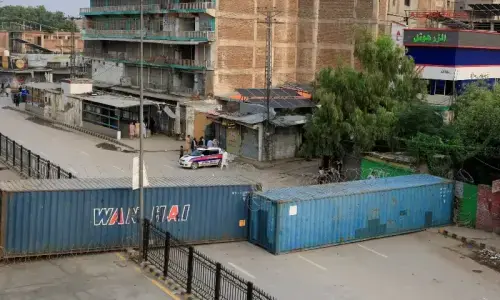
ISLAMABAD: Environmentalists within the Ministry of Climate Change have criticised the government’s plans to suspend brick kiln operations in Punjab and Islamabad as being a half-hearted effort to tackle smog, which becomes a grave environmental concern in the winter.
The ministry and the Punjab government have asked brick kiln owners to suspect activities between Oct 20 and Dec 31, when smog is most likely to form.
“Not only is there no way that the government can ensure brick kilns are turned off, the bigger question is how the government plans to compensate owners for their losses. Worse, how will the poor workforce engaged in brick-making survive for more than two months,” asked a senior official in the ministry.
Climate change ministry, Punjab govt have asked brick kiln owners to suspend activities between Oct 20 and Dec 31
Another ministry official argued that there were already rumours of the cost of bricks rising. He was interested in the government’s plan to meet the shortage of bricks that will likely emerge in those 70 days when production is suspended in Punjab and the capital.
“These are just some of the problems we can think of at the moment,” the official said.
Air pollution is Punjab’s greatest environmental concern, as well as one of Islamabad’s. In the winter, when rainfall decreases, the air is filled with particulate matter that causes obstructions in vision leading to the cancellation of flights.
This smog is caused primarily by the high volume of traffic, the incineration of garbage along roadsides and dust.
The official said scavengers must be prevented from setting garbage heaps along the Islamabad Expressway on fire, one of the major causes of air pollution over the twin cities throughout the year.
The 70-day suspension of brick kilns is in line with Lahore High Court orders following a commission’s report that emissions from brick kilns contribute to smog in the winter.
A request by the president of the Brick Kilns Association, Shoaib Khan Niazi, to reduce the length of the suspension has been denied. Mr Niazi has warned that the price of bricks is likely to rise, and consumers will end up paying more.
However, Climate Change Secretary Khizar Hayat Khan has claimed the possible price increase would only be temporary, and insignificant when it comes to protecting the environment.
“Plus, we have only requested owners of brick kilns to suspect operations voluntarily. They have agreed to cooperate with the federal and Punjab government to help keep the air clean,” Mr Khan said.
He said brick kiln owners have also been encouraged to switch to efficient zigzag technology to minimise environmentally hazardous emissions that are potential sources of particulate matter.
“This technology has been adopted from Nepal, where emissions have been reduced considerably,” he said.
Zigzag technology is similar to other firing technologies, with essential variations in brick setting patterns inside the kiln and reduced energy consumption, while the kiln’s basic structure remains nearly same.
Mr Khan also drew attention towards the sale of substandard diesel, which he said was another major contributor to air pollution and smog in particular.
“While developed countries have switched to much finer quality diesel, such as Euro 6 standard, trucks and buses in Pakistan are still running on less efficient Euro 2 standard diesel. Countries like India and Nepal have also switched to higher standards to cut emissions. We intend to keep reminding the government to upgrade diesel to higher Euro standards if the air we breathe is to be kept clean,” he said.
In response to a question, the secretary lamented that the Pakistan Environment Protection Agency lacked the capacity to monitor vehicle emissions in Islamabad.
Published in Dawn, September 24th, 2018