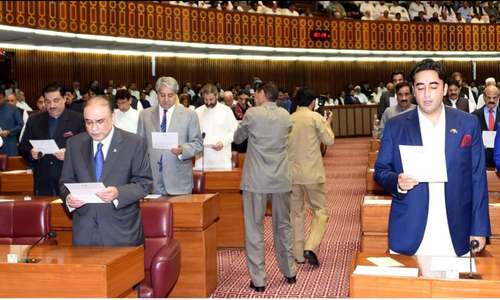
Independence day this year has a special resonance. A new parliament has been seated and the PTI is preparing to assume governing responsibilities at the centre and in more than one province for the first time.
The democratic process may be wobblier than it has been at most other points over the last decade, but democratic continuity can help create the space necessary for its strengthening.
Independence Day is an important reminder of the distance that has been travelled since 1947 as well as the many miles that have yet to be covered in order to achieve Mr Jinnah’s vision of a democratic, progressive and inclusive Pakistan.
Despite deep political divisions and institutional strife, there is an important consensus in Pakistan today: the country must hold regular elections and be governed by the Constitution. With three major parties dominating, there is also a degree of choice available to the voter.
Yet, a mixed bag of incremental gains and repeated setbacks does not make for a welcome democratic picture. One of the key problems to which there has been no solution apparent over the decades is institutional encroaching on the terrain of other institutions.
While institutions need vigorous oversight and checks and balances, the mechanisms must come from within the democratic system. A controlled democracy wherein other institutions circumscribe the authority and writ of an elected government and parliament, and impose their own policy prescriptions and priorities, is a recipe for enduring conflict.
Perhaps the PTI as a new governing party that does not have a history of institutional conflict will be able to strive for a rebalancing of the constitutional, democratic order. Whether well-intentioned or otherwise, interference by other institutions in the functioning of a government and parliament destabilises multiple facets of national life.
Incoming prime minister Imran Khan could consider inviting the superior judiciary and the military leadership to a national dialogue on respecting institutional boundaries and constraints. Clearly, business as usual must not be allowed to continue.
The civilian leadership, the security establishment and the superior judiciary tend to individually behave in a manner that suggests all fault lies with the others. Certainly, a service-oriented, publicly accountable civilian leadership can gradually create the circumstances for the installation of true civilian supremacy as the Constitution mandates and the founding father envisioned.
But there is a strong perception that the other institutions also need to cultivate within an unflinching commitment to democratic rule. As various phases of civilian rule in the country have demonstrated, a government that must constantly worry about the security of its tenure is simply unable to give its best to addressing the profound governance challenges that have endured and multiplied.
Democratic rule — true democratic rule — is not a gift that the country must wait to receive when deemed worthy of it; democratic rule is an inalienable right of each and every citizen of Pakistan.
Published in Dawn, August 14th, 2018