0
0

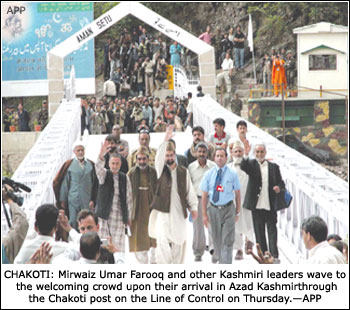 MUZAFFARABAD, June 2: Moderate leaders from occupied Kashmir said on Thursday that they must be part of the Pakistan-India dialogue as they began a landmark visit to Azad Kashmir by a peace bus that their radical colleagues preferred to miss. Nine leaders of the All Parties Hurriyat Conference (APHC) and some other groups crossed into Azad Kashmir from the Chakothi checkpoint on the Line of Control to receive an official reception and a popular welcome on a 58km route to the state capital Muzaffarabad.
Chairman of the APHC’s moderate faction Mirwaiz Omar Farooq and two other visiting leaders told a news conference later at night in Muzaffarabad that they had come to consult the Kashmiri leadership in Azad Kashmir and the Pakistan government about participation in the dialogue between Islamabad and New Delhi to settle the 57-year-old Kashmir dispute.
But they emphasized that while supporting the India-Pakistan peace process and seeking their vital participation in it, they would not countenance a “sell-out of the blood of 80,000 people killed in 15 years of uprising in occupied Kashmir”. The visit, first to Azad Kashmir and Pakistan by the political leadership of the occupied territory, is in response to an invitation from President Pervez Musharraf.
But the invitation was declined by the radical APHC group headed by Syed Ali Geelani because of his opposition to the trans-Kashmir bus service. Mirwaiz Farooq, who is also the chairman of his Awami Action Committee, said a triangular dialogue involving Pakistan, India and Kashmiris was must for a Kashmir settlement and added: “Unless Kashmiris are involved, this process will not move forward.”
He said his delegation’s trip, which would also take it to Pakistan for talks with President Musharraf, Prime Minister Shaukat Aziz and Foreign Minister Khurshid Kasuri, showed that India also now recognized that no solution to the Kashmir problem would be possible without involving Kashmiris themselves.
Mirwaiz Farooq said his delegation had come with a thinking that after tremendous sacrifices rendered by Kashmiri people, time had come to sit together to consider ways to move forward, and he hoped that his group would return with a positive idea. “This is an opportune moment,” he said and assured the people of Azad Kashmir: “Our and your future is inter-linked.”
Pro-independence Jammu and Kashmir Liberation Front (JKLF) chief Yaseen Malik said his party was not opposed to peace talks but stressed that they must have Kashmiri participation.
He acknowledged that he and other delegation members had come here on the invitation from the Pakistani president but said the credit for reaching this stage should be given to the sacrifices of 80,000 Kashmiri martyrs.
He said his present visit to Azad Kashmir was first by bus, but he had come eight times in the past after his group started armed struggle in held Kashmir. Muslim Conference president and former APHC chairman Prof Abdul Ghani Bhat said a Kashmir solution was necessary not only for India-Pakistan peace but also for peace in the whole of the nuclearized South Asia.
“If we have to banish the ghosts of an atomic war from South Asia, Kashmir issue will have to be settled,” he said.
He said absence of sincere talks on Kashmir was responsible for the failure of previous accords on Kashmir and called for holding sincere talks in a ‘forward-looking manner’. Kashmiris have to be involved in any purposeful dialogue, he added.
In reply to question, Mr Bhat justified his change of heart by coming here after his statement in October last year that he would never visit Pakistan. He said he had made that observation because he was ‘broken’ by the APHC split that he had then blamed on Pakistan.
“When the APHC split happened, it broke everything, it broke my will, it broke my conscience (and) everybody was broken,” he said.
Mr Bhat said that while inconsistency in political affairs could be no solution, one had to adjust to changes or ‘you are gone’. But he sidestepped a question that whether any effort would be made to end the estrangement of Mr Geelani, who accused the Pakistani leadership of “deviating from that country’s basic stance on Kashmir”.
But Azad Kashmir Prime Minister Sardar Sikandar Hayat and PML secretary-general Mushahid Hussain voiced their common hope in remarks to reporters that Mr Geelani would be persuaded to come to Azad Kashmir and Pakistan.
Jammu and Kashmir Democratic Freedom Party chief Shabbir Ahmed Shah was not allowed by the Indian authorities to travel because he had mentioned his nationality as Kashmiri (not Indian) in the application form.
PML president Chaudhry Shujaat Hussain, former Azad Kashmir president Sardar Abdul Qayyum Khan and leaders of various Kashmiri parties and cabinet ministers were among those who received the Kashmiri leaders as they crossed into Azad Kashmir after walking over a newly constructed 200-foot long steel bridge linking the two sides of the 180km Srinagar-Muzaffarabad road.