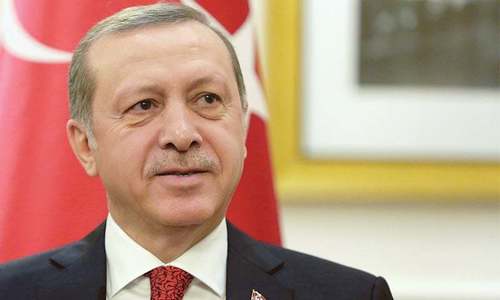
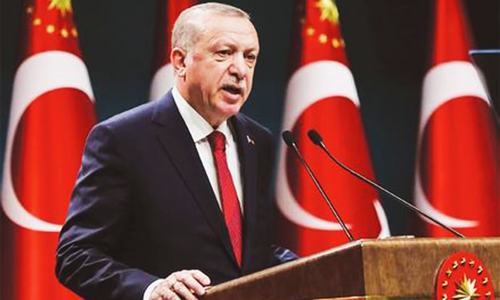
Turkish President Recep Tayyip Erdogan is to be sworn in for his second term as head of the state on Monday, taking on greater powers than any Turkish leader for decades under a new system condemned by opponents as autocratic.
Erdogan, who has transformed Turkey by allowing Islam to play a greater role in public life and boosting the country's international stature, will take his oath almost two years after defeating a bloody attempted coup.
The inauguration in parliament after Erdogan's June election victory will be followed by a lavish ceremony at his palace attended by dozens of world leaders marking the transition to the new executive presidency system.
Erdogan will face immediate and major challenges in his second term, posed by an imbalanced fast-growing economy and foreign policy tensions between the West and Turkey, a NATO member.
He has also pledged to end the state of emergency that has been in place since the failed July 2016 coup and has seen the biggest purge in the history of modern Turkey. In what appeared to be the final emergency decree issued just one day before the inauguration, 18,632 public sector employees were ordered dismissed, including thousands of soldiers and police officers.
After the inauguration, Erdogan will immediately turn to foreign policy, visiting northern Cyprus and Azerbaijan, both traditional first ports of call for a newly elected Turkish leader.
He will then head to more challenging encounters at a NATO summit in Brussels where he will meet with US counterpart Donald Trump.
Turkey's last PM
The new system was agreed in a bitterly fought 2017 referendum, but the changes have been vehemently denounced by the opposition.
The president will sit at the top of a vertical power structure marked by a slimmed-down government with 16 ministries instead of 26 and multiple bodies reporting to him.
Emre Erdogan, professor of political science at Istanbul's Bilgi University, said the parliament's powers were “highly restricted” under the new system.
In one of the most significant changes, the EU affairs ministry, set up in 2011 to oversee Turkey's faltering bid to join the bloc, will be subsumed into the foreign ministry.
Turkish Prime Minister Binali Yildirim will on Monday go down in history as the 27th and final holder of a post that has existed since Mustafa Kemal Ataturk founded modern Turkey, and whose origins date back to the Ottoman Empire.
Erdogan's ruling Justice and Development Party (AKP) on Saturday nominated Yildirim as parliament speaker, an appointment likely to be rubber-stamped by the chamber on Thursday.
Those attending the ceremony at the presidential palace on Monday evening will include Russian Prime Minister Dmitry Medvedev, in a new sign of the warm ties between Ankara and Moscow.
Among 22 heads of state attending will be Venezuelan President Nicolas Maduro, regarded with disdain by Washington but an ally of Erdogan, and Ukrainian President Petro Poroshenko.
Fresh cabinet
The new cabinet, due to be announced at 1800 GMT, is expected to have a different look, especially after Erdogan said the government would include non-AKP figures.
The most intense attention will focus on who will be responsible for foreign policy and the economy.
Current Foreign Minister Mevlut Cavusoglu could, in theory, continue in his job but reports have said Erdogan may choose his spokesman, Ibrahim Kalin, or even spy chief Hakan Fidan to succeed him.
The markets will keep a close eye on economic appointments, keen to see a steady hand at the helm in a fast-growing economy dogged by double-digit inflation and a widening current account deficit.
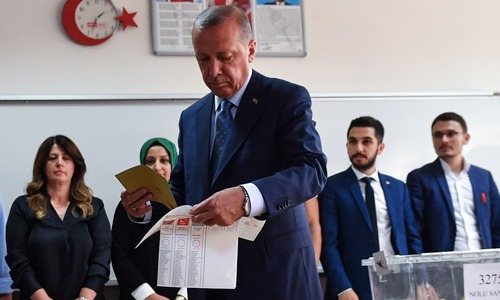
Erdogan, who first came to power as premier in 2003, won 52.6 per cent of ballots cast in June, higher than the 51.79pc he garnered in the 2014 polls.
His closest rival, Muharrem Ince of the main opposition Republican People's Party (CHP), managed 30.6pc, but the party is now locked in internal battles over its future leadership and direction.
The AKP failed to win a majority in parliament, taking 294 of the 600 seats, meaning it will need its allies in the Nationalist Movement Party (MHP), which has 49 seats, to ensure a majority.
Analysts have said that the partnership with nationalists could push the AKP into more hardline policies, notably on Kurdish issues and relations with the West.