


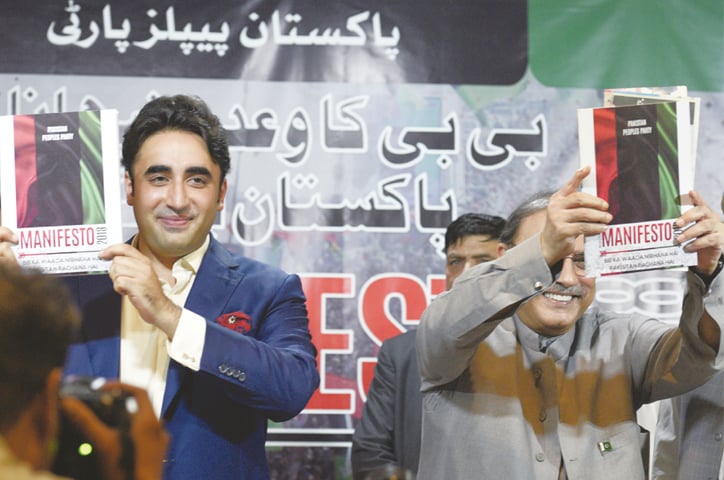
ISLAMABAD: Expressing concern over imposition of “censorship” on media, Pakistan Peoples Party chairman Bilawal Bhutto-Zardari on Thursday declared that his party would never accept “manipulated and censored democracy”.
“It is a historic occasion that a second democratic transition is about to take place in the country. On one hand, this seems to be a big step in the right direction; at the same time, the conspiracies being hatched by enemies of democracy are at their peak,” he alleged, adding that “an atmosphere of uncertainty and fear is being created”.
The young PPP chairman was speaking at the launch of his party’s election manifesto during an extremely disorganised ceremony at the National Press Club. Due to mismanagement and presence of a large number of party workers, the journalists could not put questions to the top PPP leadership, including former president Asif Zardari, Farhatullah Babar, Sherry Rehman, Aitzaz Ahsan, Murad Ali Shah and Qamar Zaman Kaira.
“Today, censorship is being imposed on freedom of expression. Such things do not happen in democracy. Today, curbs are being placed on freedom of association in an unprecedented manner,” Mr Bhutto-Zardari regretted.
Launches election manifesto of his party
“I want to say it in categorical terms in front of the masses that the PPP will not accept this kind of censored or manipulated democracy,” he said, asking the state institutions “to stay within the constitutional limits”.
The PPP chairman urged the politicians to work for the strengthening of parliament “through their attitudes”.
In an apparent reference to former prime minister Nawaz Sharif and Pakistan Tehreek-i-Insaf chief Imran Khan, Mr Bhutto-Zardari said that democracy could not be strengthened by staying away from parliament for years and by staging sit-ins and cursing the legislature.
“Benazir Bhutto made a promise to the people of Pakistan. It was the promise of a peaceful, prosperous and progressive Pakistan for all our people, and we are to fulfil her dream to save the country,” he said while referring to his party’s election slogan, BB ka waada nibhana hai, Pakistan bachana hai.
He lashed out at the policies of the PML-N government, terming the present economic situation “unstable, intolerable and unsustainable”. “Short-sighted quick fixes directed at the welfare of tiny elite have compromised the lives of the poorest and most vulnerable, denied them economic justice, and at the same time compromised Pakistan’s economic sovereignty,” he said.
He alleged that many of the measures taken by the PPP government for ensuring devolution of power had been subverted, and the momentum for further reforms had been stalled.
“All institutions for accountability were subverted. The parliament was reduced to the position of a bystander, as major crises threaten the state and the economy. State institutions appear to be at loggerheads. This raises alarm bells for Pakistan,” Mr Bhutto-Zardari warned.
“Now we pledge to free all our people from the fear of hunger, thirst and helplessness and to open opportunities for all our children and youth so that they may excel, become active citizens of Pakistan and confident members of the global community; to rebuild and build an economy that works for all our people, now and into the future; to deepen democracy by fostering harmony among our people, between our people and our state, and among the institutions of our state, and to make the government accountable and answerable to the people by strengthening the parliament and other institutional frameworks; to secure rights and peace for our state and for all our people and to reclaim Pakistan’s rightful place in the world,” the PPP chairman said while highlighting salient features of the manifesto.
He said the PPP would continue to struggle for the creation of South Punjab province, the merger of erstwhile Federally Administered Tribal Areas with Khyber Pakhtunkhwa and ending the “undemocratic steps taken by the PML-N government in Gilgit-Baltistan (GB)”.
He announced that the PPP would ensure elections in Azad Kashmir and GB simultaneously with Pakistan. He also criticised the foreign policy of the PML-N government, saying “there is absolutely no recognition of the sacrifices rendered by our brave soldiers, police and innocent civilians; instead there is a serious trust deficit and a concentrated effort [is] underway to make Pakistan a scapegoat for others’ failures”.
“We realise that many 21st century challenges recognise no borders. Terrorism and climate change require regional and global solutions, so we must always seek to be in dialogue with our neighbours and all global powers,” he said.
Mr Bhutto-Zardari stressed the need for internationalising the issue of “water terrorism” by India.
He said his party would announce massive agriculture reforms through registration of male and female farmers and by issuing the Benazir Kissan Cards. Through these cards, he said, the farmers would get direct subsidy on fertilisers and insurance of their crops in case of any natural calamity.
He said the PPP would fix the prices of DAP and urea fertilisers at Rs1,700 and Rs500, respectively.
Drawing attention towards growing unemployment, the PPP chairman said his party would launch a programme through which the youths would be guaranteed a one-year internship. He also announced setting up of an employment bureau for creation of job opportunities in the country.
He announced that the PPP after coming into power would overhaul the textile industry and make efforts to bring down the cost of doing business.
He promised lifting of ban from trade and student unions across the country. He also highlighted a number of achievements of the PPP government in Sindh in the health and education sectors and announced launching of family health cards under “Ilaj Programme” after coming into power.
He also underlined the need for taking urgent steps to resolve the issue of water shortage in the wake of reports that Pakistan could face drought-like conditions by 2025. He called for creating awareness among the masses about water conservation.
Published in Dawn, June 29th, 2018




























