Opec agrees modest hike in supply after Saudi Arabia-Iran compromise


VIENNA: Opec agreed on Friday on a modest increase in oil production from next month after its leader Saudi Arabia persuaded arch-rival Iran to cooperate, following calls from major consumers to help reduce the price of crude and avoid a supply shortage.
However, the decision confused some in the market as Opec gave opaque targets for the increase, making it difficult to understand how much more it will pump. Oil prices rose as much as 3 per cent.
“Hope Opec will increase output substantially. Need to keep prices down!” US President Donald Trump wrote on Twitter less than an hour after Opec announced its decision.
The United States, China and India had urged Vienna-based OPEC to release more supply to prevent an oil deficit that would hurt the global economy.
The Organisation of the Petroleum Exporting Countries (Opec) said in a statement that it would go back to 100pc compliance with previously agreed output cuts but gave no concrete figures.
Saudi Arabia said the move would translate into a nominal output rise of around 1 million barrels per day (bpd), or 1pc of global supply. Iraq said the real increase would be around 770,000 bpd because several countries that had suffered production declines would struggle to reach full quotas.
The deal gave a tacit green light to Saudi Arabia to produce more than currently allowed by Opec as the 14-nation organisation avoided setting individual country targets.
Iran, Opec’s third-largest producer, had demanded Opec reject calls from Trump for an increase in oil supply, arguing that he had contributed to a recent rise in prices by imposing sanctions on Iran and fellow member Venezuela.
Trump slapped fresh sanctions on Tehran in May and market watchers expect Iran’s output to drop by a third by the end of 2018. That means the country has little to gain from a deal to raise Opec output, unlike top oil exporter Saudi Arabia.
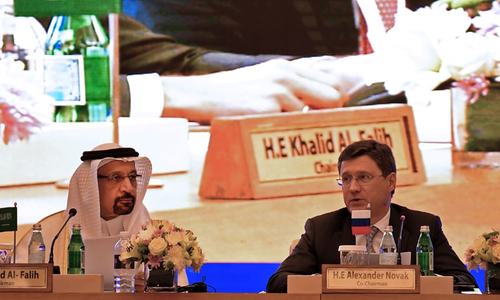
However, Saudi Energy Minister Khalid al-Falih convinced his Iranian peer Bijan Zanganeh to support the increase just hours before Friday’s Opec meeting.
Opec and its allies have since last year been participating in a pact to cut output by 1.8 million bpd. The measure had helped rebalance the market in the past 18 months and lifted oil to around $75 per barrel from as low as $27 in 2016.
But unexpected outages in Venezuela, Libya and Angola have effectively brought supply cuts to around 2.8m bpd in recent months.
The output boost agreed on Friday had been largely priced into the market and was seen as modest.
“It will be enough for now but not enough for the fourth quarter to address a decline in Iranian and Venezuelan exports,” said Gary Ross, head of global oil analytics at S&P Global.
“There isnt a lot of spare capacity in the world. If we lose a million bpd of output from Venezuela and Iran in the fourth quarter, where will all these barrels come from? We are in for higher prices for longer,” he said.
Falih has warned the world could face a supply deficit of up to 1.8m bpd in the second half of 2018 and that Opec’s responsibility was to address consumers’ worries.
“We want to prevent the shortage and the squeeze that we saw in 2007-2008,” Falih said, referring to a time when oil rallied close to $150 per barrel.
Opec’s deal to release more supply centres on returning to 100pc compliance with existing, agreed cuts. Current compliance is around 40-50pc above target because of production outages in Venezuela, Libya and Angola.
“As a group we can meet the 100pc compliance. As individual countries, it is challenging,” said United Arab Emirates Energy Minister Suhail bin Mohammed al-Mazroui.
Zanganeh has said that if Opec returned to regular compliance, the group would raise output by around 460,000 bpd. Iran has objected to having members with additional capacity such as Saudi Arabia fill Venezuelan output gaps. “Both Saudi and Iran can show that they won,” an Opec delegate said.
“Zanganeh can go back to his country and say ‘I won’, because we are keeping the original agreement unchanged. Falih can go back and say ‘we will be able to raise production to meet market needs’.”
Opec and non-Opec producers will meet on Saturday to iron out details of the pact and then again in September to review the deal. The next formal Opec meeting was set for Dec 3.
Published in Dawn, June 23rd, 2018