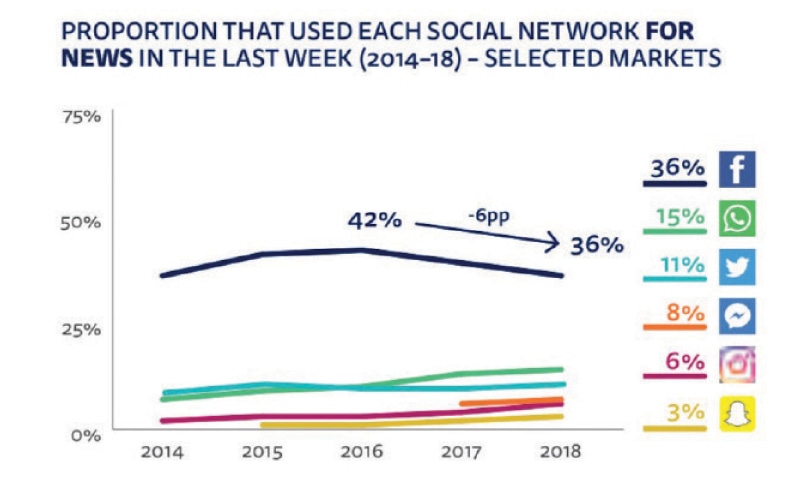
LONDON: The use of social media networks such as Facebook to consume news has started to fall in the United States as many young people turn towards messaging apps such as Facebook-owned WhatsApp to discuss events, the Reuters Institute has found.
Usage of Facebook, the world’s largest social network, for news is down 9 percentage points from 2017 in the US and down 20 points for younger audiences, according to the Reuters Institute survey of 74,000 people in 37 markets.
“The use of social media for news has started to fall in a number of key markets after years of continuous growth,” Nic Newman, research associate at the Reuters Institute for the Study of Journalism, said in the Digital News Report.
“We continue to see a rise in the use of messaging apps for news as consumers look for more private [and less confrontational] spaces to communicate,” Newman said.
Facebook and Twitter are still used by many users to discover news but the discussion then takes place on messaging apps such as WhatsApp, often because people feel less vulnerable discussing events on such apps.
“Social media is like wearing a mask,” an unidentified UK female respondent from the 30-45 age group was quoted as saying. “When I am in my messaging groups with my friends, the mask comes off and I feel like I can truly be myself.”
Some respondents still found news on Facebook but then posted items on a WhatsApp group for discussion with a closer set of friends.
Fewer than half of people surveyed across the world said they trusted the media most of the time, though in the US just 34 per cent said they trusted most news, most of the time, down 4 points.
In the US, local television news and the Wall Street Journal were the most trusted news brands while in the United Kingdom it was BBC news and ITV news.
Fox News and Breitbart were trusted more by those on the right of the political spectrum in the United States while those on the left trusted CNN more.
News brands with a broadcasting background and a long heritage tended to be trusted most, with popular newspapers and digital-born brands trusted less. Public broadcasters scored well.
The so called “Trump Bump” increase in subscriptions to news media has been maintained though more than two-thirds of respondents were unaware of problems in the news industry and thought most media were making a profit from digital news.
“The verdict is clear: people find that some news is worth paying for, but much of it is not,” said Rasmus Kleis Nielsen, director of research at the Reuters Institute.
“The challenge for publishers now is to ensure that the journalism they produce is truly distinct, relevant and valuable, and then effectively promoting it to convince people to donate or subscribe.”
Published in Dawn, June 15th, 2018