AS the country hurtles towards the chaotic flux of a fast approaching election, a critical dispute is set to be decided upon in an international forum.
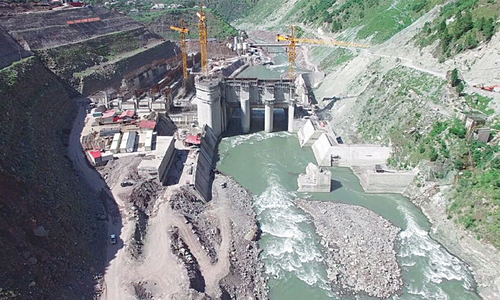
Pakistan has just activated its request for arbitration in the case of the Kishenganga Hydroelectric Project, or KHEP, that India has just commissioned on the Neelum river.
India describes KHEP as a storage work for power generation purposes only, whereas Pakistan maintains that because its design actually diverts water from the Neelum river into the Bonar Madmati Nullah, it qualifies as a breach of Article III(2) of the Indus Waters Treaty under which all the flows in the Neelum river belong to Pakistan, as well as Article IV(6) of the IWT which safeguards the natural flows of all water channels under the treaty.
This is a particularly important dispute for Pakistan because this is a hydraulic society and irrigation water from the tributaries of the Indus river system plays a vital role in sustaining livelihoods, the economy, food security and overall social stability in this country.
The Court of Arbitration, to which the dispute was originally referred in 2010, found in its first interim order that the dam component of KHEP would “eventually enable India to exercise a certain degree of control over the volume of water that will reach Pakistan” and ordered a temporary halt to construction.
A second interim order in 2013 allowed construction to resume because entitlement to prevent such diversions was based on a demonstrated utilisation of the waters in Pakistan’s territory.
Since Pakistan’s own Neelum Jhelum Hydropower Project was conceived and initiated after KHEP, the Court of Arbitration found that Pakistan did not have any demonstrated requirements for utilisation of the water of the tributary at the time when the dispute began.
Today all that is left for Pakistan to object to is the level to which the dam can be drained, particularly for desilting purposes.
The scope of the objections has been narrowed, but the implications for Pakistan have not. Prime Minister Narendra Modi has already threatened to use water as a weapon against Pakistan in 2016, even though his reference was carefully worded to refer only to the waters of the eastern rivers over which India retains full control under the treaty.
Nevertheless, the level of belligerence at the top levels of the Indian government in water politics, as well as the level of control that KHEP gives to India over Neelum river flows makes this a particularly important case for Pakistan.
The World Bank has, thus far, looked to postpone its involvement in the matter by referring it back for bilateral settlement. But that did not work.
The time has come for the bank to step up, and discharge its obligations under the IWT by taking Pakistan’s request for arbitration more seriously.
Published in Dawn, May 23rd, 2018