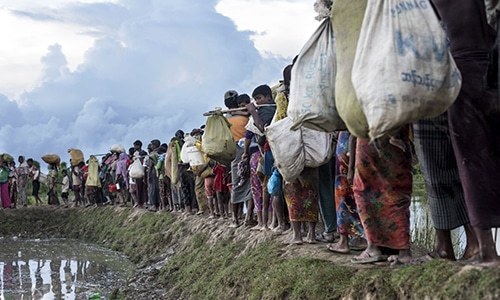
NAYPYIDAW: Myanmar must hold a “proper investigation” into alleged atrocities against the Rohingya, a UN Security Council envoy said on Tuesday, after the highest-level diplomatic visit to an area from which 700,000 members of the Muslim minority have been driven out.
Refugees and rights groups say Myanmar’s army and vigilantes systematically raped and murdered civilians and torched villages during “clearance operations” in Rakhine state ostensibly targeting Rohingya militants.
That campaign launched last August in the mainly Buddhist nation sparked the exodus of Rohingya into Bangladesh.
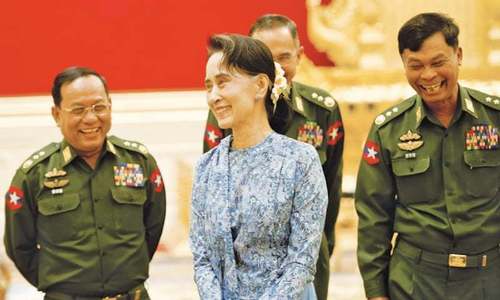
During the two-day trip to Myanmar, UN delegates travelled to Rakhine and also met both civilian leader Aung San Suu Kyi and Senior General Min Aung Hlaing, who heads an army accused by the UN of “ethnic cleansing”.
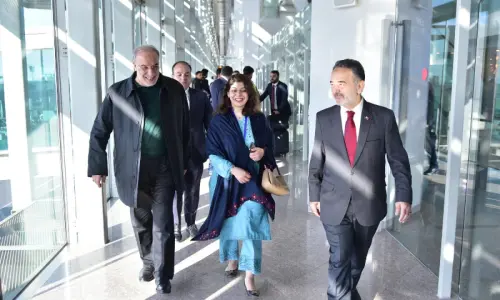
“In order to have accountability there must be a proper investigation,” Britain’s UN ambassador Karen Pierce told reporters, after envoys had visited the Rohingya refugee camps in Bangladesh and also Rakhine.
There were two ways to establish a full probe, “one is an ICC (International Criminal Court) referral”, she said. The other was for Myanmar’s government to hold its own comprehensive inquiry.
Last month the chief prosecutor for the ICC asked judges to consider whether the court’s jurisdiction extends to Myanmar, which is not a member of the panel.
Suu Kyi, pilloried outside her country for failing to speak up for the Rohingya, promised to “undertake a proper investigation” where evidence of atrocities was found, Pierce said.
“It doesn’t matter whether it [a probe] is international or domestic, as long as it’s credible,” she added.
During his meeting late Monday with the UN envoys, Myanmar’s army chief denied his forces had committed rape and other sexual abuses during the crackdown which he ordered.
“The Tatmadaw [army] is always disciplined ... and takes action against anyone who breaks the law,” he told the delegates, according to a posting late Monday on his official Facebook page.
Rohingya women and girls in Bangladesh have provided consistent accounts of sexual violence — reports verified by conflict monitors — but Min Aung Hlaing said his forces have “no such history of sexual abuse”. “It is unacceptable according to the culture and religion of our country,” he said, adding anyone found guilty of crimes would be punished.
Speed up returns
Min Aung Hlaing also repeated the official line that Myanmar was ready to take back those refugees who could be verified as residents, as per a repatriation deal with Bangladesh.
Several months after the deal was signed, no refugees have returned. They demand guarantees of safety, the right to return to their original villages and the granting of citizenship.
Another UN diplomat warned it would take “two or three years” for the refugees to be repatriated as the current timeframe to implement the deal continues to slip.
“There is a need to speed up the process,” said Mansour Ayyad Al-Otaibi, the Kuwaiti ambassador to the UN, adding conditions must be “safe and dignified” for return.
Bangladeshi accuses Myanmar of buying time by pretending to cooperate over repatriation for the benefit of the international community.
Myanmar says its neighbour has only handed back 8,000 repatriation forms so far, many of them incomplete, delaying the return process.
Myanmar denies the Rohingya citizenship and accompanying rights.
Since 2012 it has driven out two-thirds of its roughly 1.5 million Rohingya population.
Published in Dawn, May 2nd, 2018