Joint statement: major points


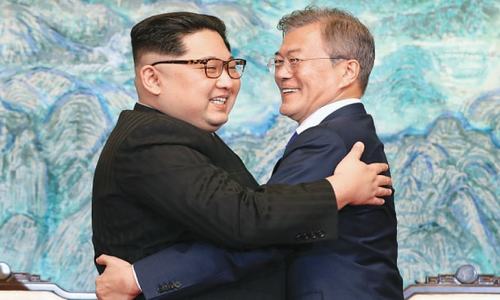
SEOUL: North Korean leader Kim Jong Un and South Korean President Moon Jae-in signed a joint statement on Friday after meeting at the heavily fortified demilitarised zone between their countries.
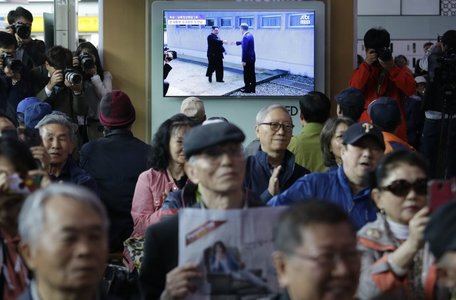
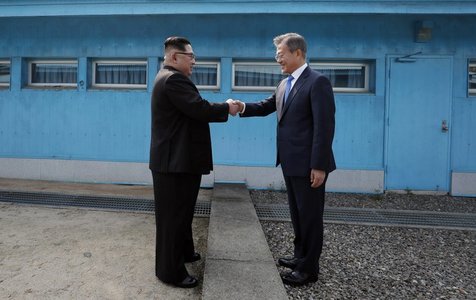
Kim became the first North Korean leader since the 1950-53 Korean War to set foot in South Korea after shaking hands with his counterpart over a concrete curb marking the border at the truce village of Panmunjom.
Here are the major points of a joint statement they issued.
Inter-Korean exchanges
• The two Koreas agree to fully implement all existing agreements and declarations adopted so far between the two sides.
• They agree to hold dialogue and negotiations in various fields including high level talks, take active measures to implement summit agreement.
• They agree to establish joint liaison office with resident representatives of both sides in the Kaesong industrial zone on their border.
• They agree to encourage more active cooperation, exchanges, visits and contacts at all levels.
• They agree to actively stage various joint events on special dates in which participants from all levels, including central and local governments, parliaments, political parties and civil organisations.
• They agree to jointly participate in international sports events such as the 2018 Asian Games.
• They agree to endeavour to swiftly resolve the humanitarian issues that resulted from the nation’s division.
• They agree to convene an Inter-Korean Red Cross Meeting to discuss and solve issues including the reunion of families separated by the Korean War.
• They agree to hold reunion programme for separated family on Aug 15.
• They agree to implement projects previously agreed in an Oct 4, 2007, declaration to promote balanced economic growth and joint prosperity.
• They agree to adopt practical steps toward connecting and modernising railways and roads between them on the eastern side of the peninsula as well as between Seoul and Sinuiju, in northwest North Korea.
Military
The two Koreas agree to completely cease all hostile acts against each other in every domain including land, sea and air.
• They agree to transform the Demiliatrised Zone into a peace zone as of May 1 by halting all hostile acts and eliminating their means, including loudspeaker broadcasts and the distribution of propaganda leaflets.
• They agree to devise a practical scheme to transform the current Northern Limit Line in the West Sea into a maritime peace zone to prevent accidental military clashes.
• They agree to hold frequent defence ministerial and working-level meetings in a bid to immediately discuss and solve military issues, with the first military talks to be held in May at the rank of general.
Peace regime
The two Koreas reaffirm and agree to strictly adhere to a Non-Aggression Agreement that precludes the use of force in any form against each other.
• They agree to carry out disarmament in a phased manner, as military tension is alleviated and substantial progress is made in military confidence-building.
• They agree to actively pursue trilateral meetings involving the United States, or quadrilateral meetings involving the United States and China with a view to declaring an end to the War and establishing a permanent and solid peace regime.
• They confirm the common goal of realising, through complete denuclearisation, a nuclear-free Korean peninsula.
Published in Dawn, April 28th, 2018