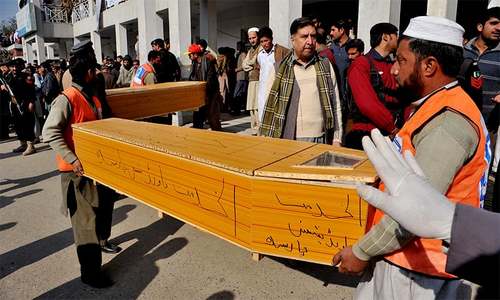
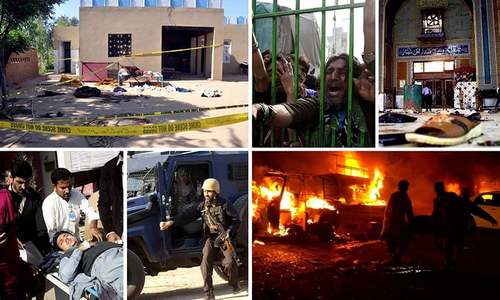
WASHINGTON: Terrorism fatalities in Pakistan decreased by almost 40 per cent between 2016 and 2017, says a US State Department report released on Friday.
The department’s annual country report on human rights notes that at the end of October 2017, terrorism fatalities in Pakistan stood at 1,084, in comparison with 1,803 fatalities in the full year 2016.
The data, collected for the South Asia Terrorism Portal (SATP), indicated a 39.878 per cent decrease, which would have improved further if data for the last two months of 2017 were also included.
The US report points out that terrorist violence and human rights abuses by non-state actors contributed to human rights problems in the country.
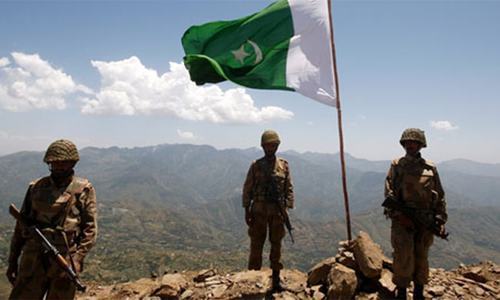
“The military sustained significant campaigns against militant and terrorist groups. Nevertheless, violence, abuse, and social and religious intolerance by militant organisations and other non-state actors, both local and foreign, contributed to a culture of lawlessness in some parts of the country,” the report adds. This was more obvious in Balochistan, Sindh, Khyber Pakhtunkhwa (KP), and the Federally Administered Tribal Areas (Fata).
The State Department report also highlights the issue of forced disappearances in Pakistan, noting that in 2017, “there were kidnappings and forced disappearances of persons from various backgrounds in nearly all areas of the country. Some police and security forces reportedly held prisoners incommunicado and refused to disclose their location”.
The report mentions disappearance of MQM workers in Karachi and of nationalists in interior Sindh, Balochistan and KP.
The report also alleges that dozens of political workers and activists were kidnapped, tortured and killed in all these places.
The US State Department notes that the Commission of Inquiry on Enforced Disappearances received 4,608 missing person cases. The commission claimed to have closed 3,076 of those cases, while 1,532 remained open.
Data from the commission showed the number of persons reported missing was highest in KP (751 missing), followed by Punjab (245 missing), Balochistan (98 missing), Sindh (50 missing), Fata (48 missing), the Islamabad Capital Territory (45 missing), Azad Jammu and Kashmir (AJK) (14 missing), and Gilgit-Baltistan (five missing).
The most significant human rights issues identified in the report include extrajudicial and targeted killings, disappearances, torture, lack of rule of law and frequent mob violence and vigilante justice with limited accountability.
Additional problems identified in the report are arbitrary detention, lengthy pre-trial detention, a lack of judicial independence in the lower courts, governmental infringement on citizens’ privacy rights, harassment of journalists, and high-profile attacks against journalists and media organisations.
Government restrictions on freedom of assembly, freedom of movement and freedom of religion and discrimination against religious minorities, and sectarian violence have also continued.
Corruption within the government and police, lack of criminal investigations or accountability for cases related to rape, violence-based on gender, gender identity and sexual orientation, sexual harassment, so-called honour crimes, and female genital mutilation/cutting remain problems.
Child labour resulting in frequent exposure to violence and human trafficking, including forced and bonded labour, has also persisted.
Published in Dawn, April 21st, 2018