MY weekends in Istanbul are usually spent in coffee places in the neighbourhood of Besiktas. The district is dominated by a young-urban population from different backgrounds. One coffee place that I frequently visit has Muhammad Iqbal’s verse suspended in a frame on the café’s wall. The verse is from the poem ‘Dialogue between God and Man’, which occurs in Payam-i-Mashriq (Message from the East): “You created the night, I made the lamp.”
Journeying across Turkey as a young Pakistani, I have come across various aspects of life that a vibrant historic society has to offer: architecture, cuisine, poetry, philosophy, and intellectual thought. There have been times I’ve stumbled onto conversational exchanges with strangers while taking a taxi ride or having a cup of tea at a random place. “Where are you from?” I get asked. “Pakistan,” I reply. “Oh, do you know Muhammad Iqbal?” I get asked in return.
In the past four years, I have lost count of how many times my identity as a Pakistani has been associated with one of the most pioneering intellectuals of the region to which I belong. What intrigues me the most is that this association has been made not by well-versed academics or students, but by street vendors and tea-sellers.
Special report: The enduring vision of Iqbal 1877-1938
It has been these conversations that intrigued me enough to try to understand Iqbal’s thought in depth. The fact that he is widely celebrated within Turkish intellectual society has been a pivotal point in my experience here to understand what made him so versatile and treasured.
One of the key factors for Muhammad Iqbal to be celebrated by individuals in the Turkish state is his contribution to Muslim political thought. He got his education in Western societies, composed his prose and ideas in more than one language, and at the same time experienced British colonialism and how Muslims in the subcontinent experienced it. Also, at the same time, Iqbal keenly observed events in Turkey as well — the Balkan wars, the abolishment of the caliphate and the rise of the modern republic.
Professor Rahim Acar from Marmara University said, “Iqbal is very important for modern Islamic thought. He was well-versed in Islamic culture, was educated in the West, and understood the challenges that Western and Muslim societies in the context of his times came with. In Turkish society during the same period, when the events of World War 1 were unfolding, there were no scholars who thought with the same intensity and profundity as Iqbal.”
Iqbal’s Reconstruction of Religious Thought in Islam is regarded as one of the pioneering works in modern Islamic thought. He believed that nations in the Islamic world must accept their own vision, and form an autonomy of their own existence. This would allow every nation to reflect on its drawbacks, understand its essence as a community, and hence prove a sounder Islamic identity.
It is no wonder that his interpretation on the revival and evolution of Islam enticed the Turkish intelligentsia to study him and adapt his thoughts. “The founder of a course on the philosophy of religion within the faculty of theology in Turkey, Mehmet Aydin, has studied Iqbal immensely and put forth his thought in his perspective,” said Acar. “Scholars who study him feel affiliated with his distinction when it comes to philosophy and theology.”
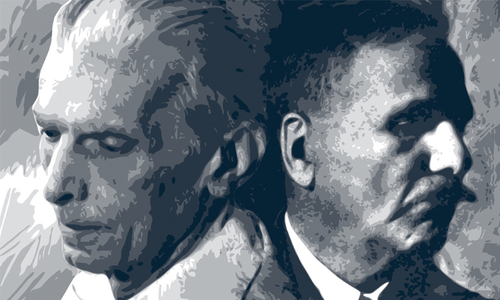
Professor Acar also drew common ground between Muhammad Iqbal and Mehmet Akif Ersoy. “He is like our intellectual Mehmet Akif Ersoy,” he commented. “They were both philosophers and national poets around the same context of time.” This statement came as no surprise. I recall coming across a joint commemorative postage stamp celebrating the 70th anniversary of diplomatic relations between Turkey and Pakistan: it carried images of both intellectuals side by side.
During a discussion with a Dutch correspondent in Istanbul, Melvyn Ingleby, I realised the timelessness and influence of Iqbal’s work, even today. “What intrigued me about Iqbal was his parallels with Nietzsche’s thought,” said Ingleby. “He has universality when it comes to the critique of modern thought.”
It’s also necessary to highlight Iqbal’s fondness for the 13th century scholar and Sufi poet, Jalaluddin Rumi, who is buried in Konya — also known as the city of dervishes. The extent of spiritual influence Rumi had on Iqbal is such that there is a memorial placed close to Rumi’s burial place, which says: “The memorial has been erected to commemorate Pakistan’s national poet and thinker, Muhammad Iqbal, in the presence of his esteemed spiritual mentor Jalaluddin Rumi.”
Iqbal is the epitome of intellectual thought. His legacy and Islamic thought not just hold vital characteristic, give hope, and mellow the hearts of people from the subcontinental region, they also echo with the people of Turkey and the world. As we commemorate Iqbal’s 80th death anniversary on April 21, it needs to be realised that he is amongst Pakistan’s intellectual pillars. His thought merges the spiritual journey of man in different stages and reflects on the evolution of being and community, even today.
Published in Dawn, April 20th, 2018