IT is a reality check and a warning against complacency. The recent arrest of members of a ‘group of terrorists’ linked with the banned Tehreek-i-Taliban Pakistan from Lahore, Gujranwala and some other districts in Punjab is a grim reminder of the widespread threat that continues to persist in the province in spite of a considerable decrease in militant violence over the last couple of years.
The suspects were said to be responsible for launching at least two suicide attacks from a madressah in Lahore last year against army personnel on Bedian Road and policemen on Ferozepur Road.
The provincial counterterrorism department claimed that the militants had planned to target the Pakistan Super League matches in Lahore this month.
They also had plans to hit politicians and imambargahs just before their network was busted by the department in a joint operation with the Intelligence Bureau.
The capture of these militants indicates that Punjab has still to come out of a phase in which it is vulnerable to terrorist attacks, besides being viewed as a nursery of terrorism.
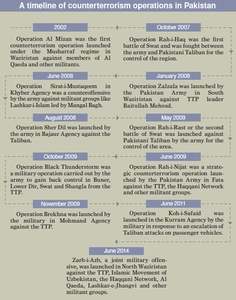
It appears that all the calls to the people to celebrate victory against terrorism outfits have been premature. The so-called intelligence-based crackdown on militants including sectarian groups in the province, launched as part of a nationwide operation in the aftermath of the 2014 APS attack in Peshawar, has succeeded only to a point in the effort to secure the people — even those living in major cities where the law-enforcement agencies carry out stronger checks.
Indeed, the agencies have hunted down a number of militants over the last few years, averting several potential terrorist attacks. The perpetrators of several sectarian and terrorist strikes across the province have also been captured, killed or convicted.
But the fact remains that the government has not been able to completely dismantle the terrorist infrastructure.
Much deradicalisation also needs to be carried out at various levels. Politicians, including those belonging to the ruling PML-N, openly associate themselves with one extremist group or the other if that can help prop up their electoral chances.
It is well known that a majority of militant attacks in Pakistan are ordered, planned and financed by the TTP leadership based in neighbouring Afghanistan.
The state has provided Kabul with strong evidence about the existence of sanctuaries of the banned TTP and Jamaatul Ahrar in that country, and has asked the Afghan government to take effective action against them.
It is important to sever the links that sustain terrorist networks — including the sponsors of terrorism and its local facilitators.
This, however, doesn’t mean that we neglect the task of monitoring our own territory while concentrating obsessively on the threat emanating from across the border. There must be no hesitation in dismantling militant infrastructure across the country.
Published in Dawn, March 31st, 2018