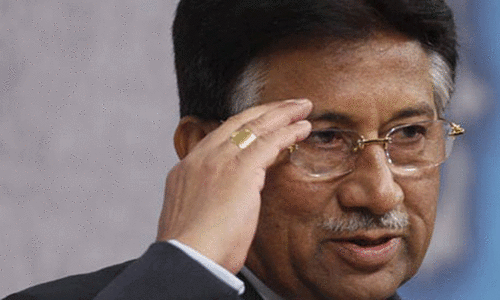
ISLAMABAD: The trial of former dictator retired General Pervez Musharraf is likely to be delayed further as a member of the three-judge bench on Thursday recused himself from the proceedings of the treason case.
The special court that was seized with the case after several months of adjournment had resumed proceedings against Mr Musharraf on March 8.
The court had directed the federal government to suspend the diplomatic passport and computerised national identity card of Mr Musharraf, besides taking steps for his extradition to Pakistan and had adjourned the matter to March 21.
However, the three-judge special court — comprising Peshawar High Court Chief Justice Yahya Afridi, Lahore High Court Chief Justice Yawar Ali and Balochistan High Court Chief Justice Tahira Safdar — was not convened on the date for security reasons and the hearing was postponed till March 29.
On Thursday, the special court was scheduled to start proceedings at 9am. However, the judges summoned chief prosecutor Mohammad Akram Sheikh and the counsel representing Mr Musharraf to the chamber and after the in-camera proceeding issued the order of the day.
Journalists were waiting for the resumption of the proceedings, but at 12 noon they were informed that one of the judges had recused himself from hearing the case.
As per the written order of the court, Mr Musharraf’s counsel Akhtar Shah had raised the objection that Justice Afridi was a counsel for ex-chief justice Iftikhar Mohammad Chaudhry and had challenged the imposition of Nov 3, 2007 emergency. It is worth mentioning that the former military dictator is facing the high treason case for imposition of the same emergency.
The court order stated: “The above assertion of the accused-respondent is factually not correct. Mr Justice Yahya Afridi has never been a counsel holding the brief on behalf of Mr Justice (retired) Iftikhar Mohammad Chaudhry.” It added that Justice Afridi had challenged the emergency as a co-petitioner before the apex court.
According to the court’s order, “to ensure complete impartiality and upholding the principle of natural justice and fair trial, Mr Justice Yahya Afridi has decided to recuse himself from hearing the instant case”.
Talking to Dawn, chief prosecutor Akram Sheikh said that the special court should have not entertained this petition because being a fugitive from justice, Mr Musharraf had no right to file any application.
He said that the sudden recusal of the judge would delay the case which had been pending adjudication since 2013. However, he expressed the hope that Chief Justice of Pakistan Mian Saqib Nisar would take personal interest in the matter as he had done for the re-appointment of the accountability judge, Mohammad Bashir, and the special court would get the replacement in the next few days.
“I hope CJP Nisar would make a suitable appointment to the vacant seat which would reflect his resolve to ensure supremacy of the Constitution and the rule of law,” he said.
Published in Dawn, March 30th, 2018