‘POLYMATHY’ is a word derived from two Greek roots meaning ‘much’ and ‘to learn’. A ‘polymath’ was a person who had learned much and his or her knowledge and skills spanned across various disciplines.
Though polymathy is a concept developed during the Renaissance and now the body of knowledge has become too vast and too complex for a single human being to cover even a few intellectual and artistic disciplines, there still are some persons whose wide knowledge and works in numerous fields make them deserve the title of polymath. Shanul Haq Haqqee (1917-2005) was one of those rare modern-day scholars of Urdu who had multifaceted exposure to the world of learning and scholarship: he knew many languages including Sanskrit, was a poet and wrote for children as well. He fully applied his deep study of linguistics and the art of lexicography when compiling Urdu dictionary for Urdu Development Board, later Urdu Dictionary Board (UDB), in its early stages.
Haqqee was a great connoisseur of the Urdu language as is evident in his writings. He was a fine translator who rendered some great works into Urdu, such as Antony and Cleopatra by Shakespeare and Arthashastra, the treatise on the art of governance and politics, written by the famous Hindu philosopher Kautilya Chanakiya, also known as the ancient Machiavelli. Haqqee also translated Bhagvad Geeta into Urdu.
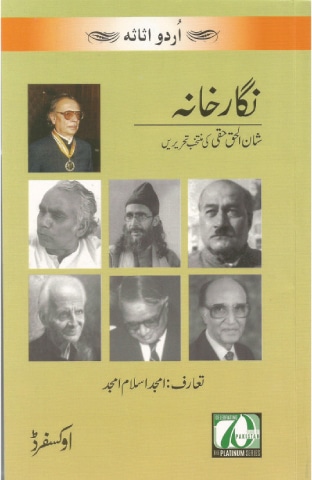
Aside from poetry, critical works and articles on language and linguistics, Haqqee penned some prose pieces on his contemporary writers and poets. Some of these pieces were included in his previous books like Nukta-i-raaz (Karachi, 1972), but many were scattered. Now some pieces written by Haqqee on his contemporaries and some senior writers have been collected in a volume titled Nigar khana: Shanul Haq Haqqee ki muntakhab tehreeren. The subtitle hints at the fact that these are the selected writings of Haqqee’s and a few of them were included in some books earlier. So collecting these pieces is indeed a nice job especially for those who love to read Haqqee’s brand of Urdu: chaste, effortless, and authentic. It comes with a lovely and sparingly-used whiff of classical Urdu prose. It is studded with so many long-forgotten words and idioms of Urdu — which also serve as authoritative citations — and no lexicographers of Urdu can afford to ignore Haqqee’s writings.
As the title suggests, it is a picture gallery where Haqqee has hung portraits that he has painted with love and care. As Haqqee belonged to a generation and background where observance of traditions and customs was an essential part of culture, he does not seem to have even a slightest intention to mutilate the faces that he loves and has painted with a rich hue of respect and love. For instance, despite Haqqee’s differences with Moulvi Abdul Haq on several issues, Haqqee has been ever so careful as not to say anything unpleasant about him. In the piece on Abdul Haq, Haqqee seems grieved for going to see Abdul Haq when he was on his deathbed as Haqqee felt that Abdul Haq was somehow pained to see him. Perhaps it was the acrimonious controversy that lingered on long after the death of Haqqee’s father, Ehteshamuddin Haqqee, who is said to be the real author of Lughat-i-kabeer, the incomplete Urdu-Urdu dictionary that later appeared with Moulvi Abdul Haq’s name on its title as compiler.
The norms and mores of a culture that we can now hardly visualise are also reflected in Haqqee’s piece on Josh Maleehabadi. Though Josh had written some unflattering remarks in his autobiography Yaadon ki baraat about Haqqee, linking Haqqee to his ouster from UDB, Haqqee has shown his gratefulness to Josh for admiring his work and acumen of lexicography. Haqqee could have easily written the reasons that cost Josh his job at UDB (one of them was Josh’s unrestrained comments about Pakistan and Ayub Khan, the then military ruler), but he just mentioned that “Josh would create problems for himself and others”.
One can understand that Haqqee, being the secretary of the board and at the helm of affairs at UDB, must have suffered a lot at the hands of those who mattered, but Haqqee, keeping in line with the tradition, has evaded the controversy and passed swiftly and unscathed from such treacherous grounds.
As for the controversy with Moulvi Abdul Haq, Haqqee has shed some light in another piece included in the book, titled Nadan Dehlvi (as it was the pen name of Haqqee’s father), but even in that piece Haqqee has shown full respect for Abdul Haq’s personality and his services for Urdu.
Published by Oxford University Press Pakistan, though the book at times sounds excessively admiring, it makes one nostalgic and the past seems like another country. They indeed did things differently in the past. Now the norm in our society is name-calling and maligning others senselessly.
Published in Dawn, February 20th, 2018