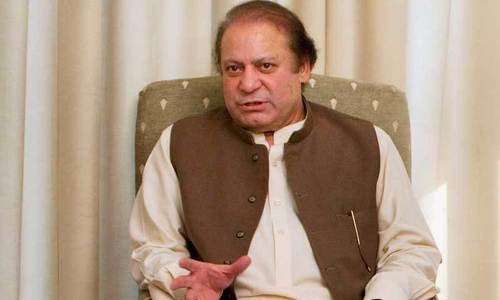
WASHINGTON: Prime Minister Shahid Khaqan Abbasi has said that after his predecessor Nawaz Sharif’s disqualification, tensions between the government and armed forces have eased.
In an interview to a panel of journalists from the Bloomberg news agency, Mr Abbasi said there was no military solution to the conflict in Afghanistan. He warned that little progress would be made until all sides entered into peace talks. In a report based on the interview, Bloomberg observed that with elections scheduled in less than six months, the government was “keen not to agitate the military”.
Mr Abbasi admitted that “there was a lot of friction institutionally that built up over the last year”.
The report, which describes the prime minister’s comments as “relatively candid”, included another quote from the interview, saying: “We have had some frank discussions — there’s much better understanding, it’s still an evolving relationship, there’s a consensus on most issues.”
Voicing scepticism over US President Donald Trump’s Afghan strategy, Mr Abbasi said that Islamabad was ready to help mediate talks with the Taliban because “at the end of the day the Afghans have to sit down and talk”.
“These are Afghan nationals who were arrested inside Pakistan, they were not involved in a terror attack on us otherwise we would have prosecuted them here, so we handed them back to the Afghans,” he said.
Mr Abbasi said that the handing over of over 27 Taliban and Haqqani network insurgents to Afghanistan in November was a “routine” prisoner transfer.” About the US decision to suspend security assistance to Pakistan, Mr Abbasi said that US military funding was already “very minimal” and Pakistan was still owed billions of dollars in reimbursements from the Coalition Support Fund.
Despite the aid suspension, Pakistan wasn’t considering closing US supply routes into landlocked Afghanistan, he added. Pakistan, he said, would also continue intelligence cooperation with the US. Mr Abbasi said that a growing relationship with China shouldn’t stop Pakistan’s cooperation with the US as these were not mutually exclusive relationships and nobody wanted it to be so.
He said that he believed the relationship with China was more of a longer term...“a deeper relationship, the US is probably more transactional”.
Mr Abbasi said that Pakistan had taken action against the charities linked to Hafiz Saeed, who was released from house arrest in Lahore in November.
In the last two to three months, Pakistan had “more or less complied” with sanctions against the Falah-i-Insaniat Foundation and Jamaatud Dawa, he said. More action against Saeed was unlikely as “we have no charges against him,” he added.
Published in Dawn, February 6th, 2018