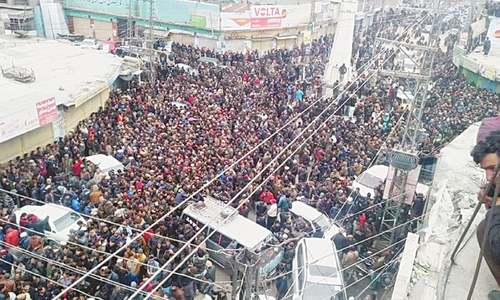
GILGIT: Protesters agreed on Wednesday to end their march on Gilgit after reaching an agreement with the Gilgit-Baltistan (GB) government.
After a seven-day-long shutter-down and wheel-jam strike across GB against imposition of taxes, the GB government bowed down before the protesters and agreed to withdraw all taxes being imposed in the region.
The regional government that was reluctant to withdraw taxes — like income tax, withholding tax and banking transaction tax — despite a complete strike in all 10 districts of the region in the last seven days has accepted almost all demands of the protesters.
As a result of the agreement with the government, the protesters will end the march on Gilgit, the provincial capital of Gilgit-Baltistan. However, their protest would continue till issuance of a notification regarding withdrawal of taxes.
The representatives of traders, GB Awami Action Committee, and government representatives, after holding talks for two days, signed the agreement on Wednesday.
The copy of the agreement is available with Dawn under which the provincial government has announced it will withdraw the GB Adaptation Act, 2012, the major demand of people in the area.
Income tax, withholding tax and other taxes had been imposed through the act.
Bowing down to the demands of thousands of people, the regional government agreed to completely withdraw the act through a notification from the Gilgit-Baltistan Council, which is the implementing body of taxes in GB.
The agreement was signed by GB’s senior minister Akabar Taban, deputy speaker Jaffarullah Khan, law minister Aurangzeb Khan, opposition leader in the GB Legislative Assembly Mohammad Shafi Khan, PPP member of the assembly Imran Nadeem Shigri, GB Awami Action Committee president Maulana Sultan Raees, Anjuman Tajiran president Mohammad Ibrahim and others.
As per terms of the agreement, the representatives of protesters and regional government will shortly visit Islamabad with their recommendations to finalise the withdrawal process of taxes through GB Council.
Another point is related to GB Minerals Policy, 2016, in which the government agreed to amend the policy and shift the subject of mineral policy to the GB Legislative Assembly.
The government has also agreed to get due share of all indirect taxes being collected by the federal government as per arrangements being followed in the case of Azad Jammu and Kashmir. The government will withdraw all cases registered against leaders of protesters and no FIR will be lodged against them in future.
Under the agreement, the protesters who were on their way to Gilgit will end the march. The two sides also agreed that after the settlement of the issue, the legislative assembly may pass a law regarding taxes on multinational companies and big organisations working in GB in future.
GB Chief Minister Hafeezur Rahman will address a press conference on Thursday (today).
Published in Dawn, December 28th, 2017