Tribal people’s consent must for KP-Fata merger: Afghan envoy


 16
16


PESHAWAR: A senior Afghan diplomat on Wednesday cautiously responded to a question over the proposed merger of the Federally Administered Tribal Areas with Khyber Pakhtunkhwa and suggested that tribal people’s consent be sought before taking a decision on the matter.
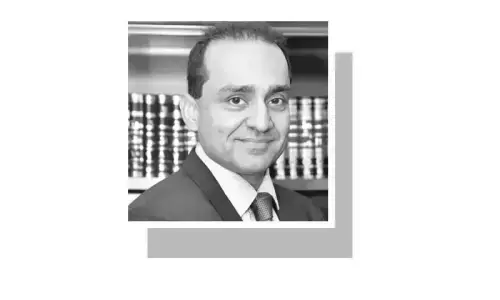
“Our government has no reservations over the merger, but the opinion of the people of the area is paramount before taking such a major decision,” said Peshawar-based Afghan consul general Mohammad Moeen Marastial at a news conference at the press club on Wednesday.
When a reporter sought the Afghan government’s stance on the proposed Fata-KP merger, Mr Marastial said the opinion of the people should be taken into consideration before taking major decisions, though Kabul had no reservations over the merger.
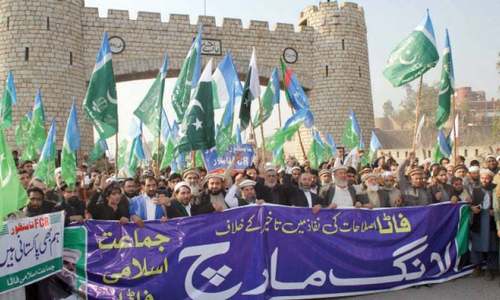
The Afghan diplomat’s statement appears to support the stance of the Jamiat Ulema-i-Islam-Fazl, which also calls for obtaining the consent of the tribal people before the merger. Like the JUI-F, the Pakhtunkhwa Milli Awami Party (PkMAP) also has serious apprehensions over the merger plan.
Marastial says Chabahar port will not affect Afghanistan’s trade with Pakistan
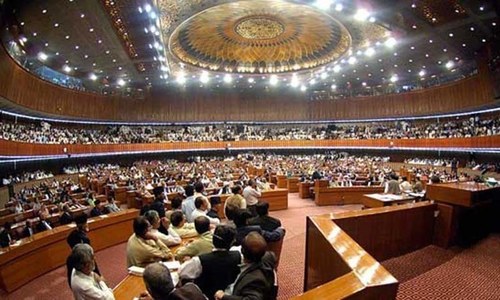
Giving a statement in the National Assembly last Friday, PkMAP chief Mehmood Khan Achakzai had warned that it was a “sensitive issue” and Afghanistan could raise objections to any move to change the status of Fata.
Mr Marastial said that Iran’s Chabahar port would not affect his country’s trade with Pakistan, adding that Chabahar would facilitate trade among Iran, Afghanistan and Central Asian states, while the Karachi port would cater to commercial requirements of Pakistan and Afghanistan.
“Chabahar port will have no effect on bilateral trade between Afghanistan and Pakistan,” he said, adding that cordial relations between Pakistan and Afghanistan could bridge ties among regional countries. The first phase of the Chabahar port was inaugurated early this month and it will serve as an alternative trade route to landlocked Afghanistan.
The educationist-turned-diplomat Moeen Marastial recently took charge in Peshawar. He replaced Abdul Waheed Poyan who has been posed as consul general in Karachi. Before his assignment in Peshawar, he was associate professor in Kabul University.
Mr Marastial was of the view that Kabul and Islamabad should improve relations and cooperation in different fields, including trade, education, culture and transport, instead of dragging their feet on political issues.
“Economic, trade and cultural ties can pave the way for resolving political issues between the two neighbours,” he said, adding that both countries should first improve trade and cultural relations. He said the consulate had very limited objectives and he wanted to strengthen relations with Pakistan in different sectors, including education, transport and culture.
“I will try my best not to involve the Peshawar consulate in political disputes,” he said and added that soon after taking charge he held a meeting with academicians and traders. He said that Islamia College University had increased reserved seats for Afghan students from nine to 15. Similarly, on his request, he said, the KP government had simplified admission process for refugees in schools and colleges. He called for greater cooperation and exchange of delegations between Pakistani and Afghan universities.
In reply to a question, the consul general said that Pakistan and Afghanistan were suffering due to prevailing lawlessness and, therefore, they should make joint efforts to bring about a lasting peace.
He said that other powers, including America, China, Iran and India, were protecting their own interests in the region and Pakistan and Afghanistan should also safeguard their mutual interests.
Mr Marastial categorically stated that Afghanistan would not allow any group or country to use its soil against any country, including Pakistan.
Published in Dawn, December 21st, 2017